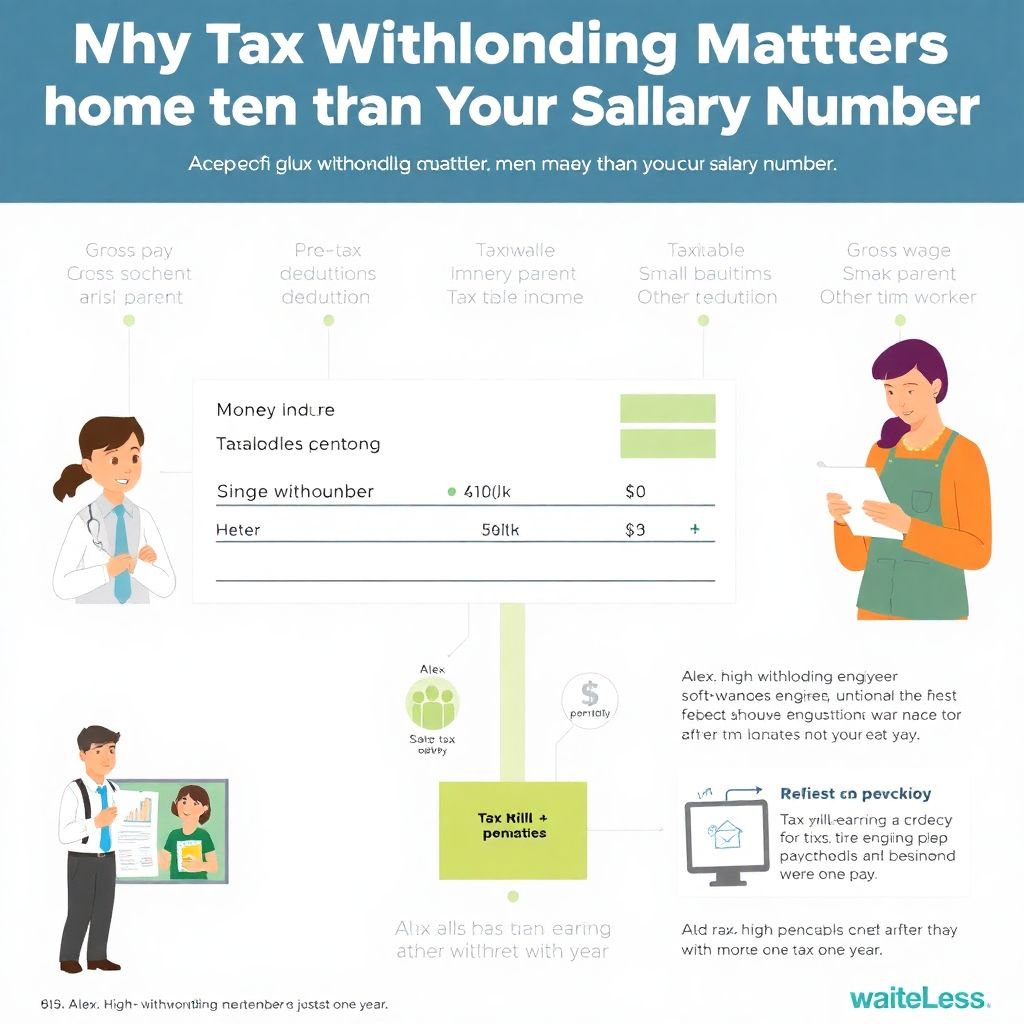
Why Tax Withholding Matters More Than Your Salary Number
When people look at a job offer, they focus on the gross salary and then feel cheated when the first paycheck arrives smaller than expected. The gap is driven by tax withholding: money your employer sends directly to the government on your behalf. It covers federal income tax, Social Security, Medicare, and often state and local taxes. Think of it as a forced savings plan for your tax bill. You either pay gradually via paychecks or try to pay a big lump sum in April, plus possible penalties if you underpaid all year.
Key Terms Without the Jargon
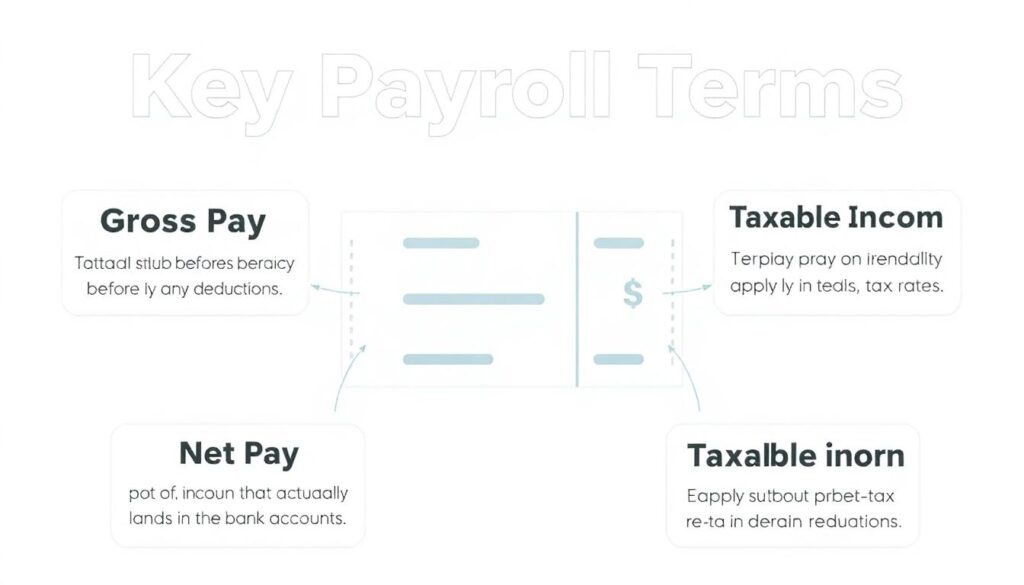
Let’s decode the words that clutter your pay stub. Gross pay is what you earn before anything is taken out. Net pay is what actually lands in your bank account. Taxable income is the portion of your income that the IRS and states use to apply tax rates after subtracting pre-tax benefits and certain deductions. Withholding is the running estimate your employer sends in each payday. A quick mental picture:
[Diagram: “Gross pay → pre-tax deductions → taxable income → tax withholding → other deductions → net pay” in a left-to-right flow.]
Diagrams in Your Head: How The Money Flows
Imagine your paycheck as a pipeline. At the start is your gross wage. First branch: retirement and health premiums reduce what can be taxed. Second branch: the employer applies something similar to a federal income tax withholding table 2025 (the IRS updates these annually) to estimate how much goes to the IRS. Third branch: state and local taxes, if any. Final outlet: what’s left is your spendable cash.
[Diagram: Vertical pipe with side taps labeled “401(k)”, “Health”, “Federal tax”, “State tax”, ending in “Net pay bucket”.]
Real-World Case 1: Surprise Tax Bill for a High Earner
Consider Alex, a software engineer earning bonuses and stock. His HR system defaulted to a basic marital status and few adjustments, so his withholding was tuned for a simpler income profile. At tax time he owed several thousand dollars and penalties. He later used a paycheck tax withholding calculator and discovered that his bonuses treated as regular pay pushed him into higher marginal brackets. After increasing his withholding and spreading deductions accurately across the year, the next April he ended up close to break-even.
Real-World Case 2: Living Paycheck to Paycheck

Now meet Mia, a single parent who cares more about cashflow than a big refund. Her default settings withheld too much; she kept getting a large refund while struggling to pay monthly bills. She learned how to change tax withholding on paycheck through her employer portal and the IRS estimator. By lowering her withholding and adjusting child-related credits on her W‑4, she shifted about $200 per month from the government’s “free loan” back into her budget, while still avoiding an underpayment penalty.
W‑4 Form: How to Fill Out for Maximum Paycheck (Without Regret)
The W‑4 controls the formula your employer uses. When people search “w4 form how to fill out for maximum paycheck”, they often just want more cash now. That’s fine, but it has trade‑offs. Claiming more credits and making fewer extra withholding elections boosts take‑home pay, yet increases the risk of owing at filing time. A balanced approach is to start with the IRS estimator, dial in realistic income and dependents, then simulate a small refund target rather than chasing the absolute highest paycheck.
Analytical Comparison: Over‑Withholding vs Under‑Withholding
You can view your strategy like two extreme models. Model A: heavy withholding. Pros: likely refund, minimal surprise, good for those without savings discipline. Cons: government holds your money interest‑free. Model B: very light withholding. Pros: maximum monthly cash, useful for debt payoff or investing. Cons: risk of large tax bill and penalties.
[Diagram: Two scales, one labeled “High Withholding = Safety, Low Cash” and the other “Low Withholding = Cash Now, Risk Later”.]
Step‑By‑Step: Tuning Your Withholding Intelligently
1. Run numbers with a paycheck tax withholding calculator, using your year‑to‑date income.
2. Compare the calculated annual tax with what’s already withheld; project the year-end gap.
3. Adjust your W‑4 so that remaining pay periods cover the shortfall without overdoing it.
4. Recheck after big events: raise, bonus, second job, marriage, or buying a home.
5. Review quarterly; small tweaks are easier than fixing a huge problem in March.
Where Payroll Tech Helps (and Where It Doesn’t)
Many employers use online payroll services with automatic tax withholding, which handle the math behind the scenes. These systems faithfully apply the rules based on your W‑4 inputs and tax tables, but they can’t judge your full financial picture: side gigs, investment income, or spouse’s earnings remain invisible unless you tell the system via your W‑4. Think of payroll software as a calculator, not a planner. It will not warn you that a giant freelance project is about to wreck your tidy withholding setup.
Final Case: Two Jobs, One Confused Taxpayer
Jamal worked two part‑time jobs, each with modest wages. Separately, every employer’s system assumed a low annual income, so withholding was tiny. Combined, his income landed in a higher bracket, leaving him with a big payment due. Once he understood this, he used the “multiple jobs” section of the W‑4 at his main job and used an online paycheck tax withholding calculator to test scenarios. The following year, both jobs together withheld enough, and his April tax bill shrank to a manageable amount.