Historical background: why paychecks look so confusing
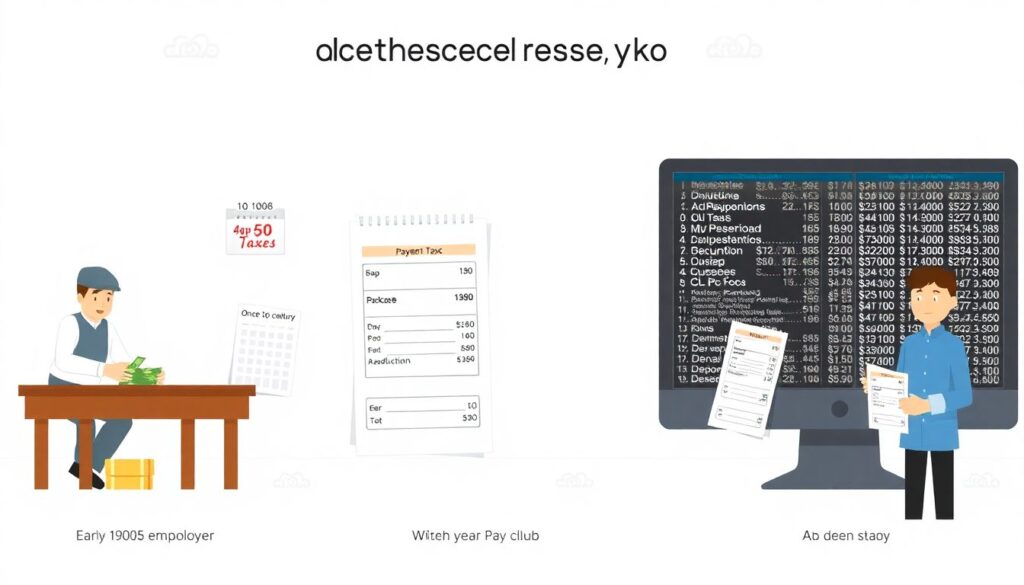
If your paycheck looks like a secret code, that’s not an accident. Modern stubs are the result of decades of tax laws, benefit programs, and digital payroll software piling on top of each other. Early in the 20th century, most people were paid in cash, and income taxes were settled once a year. As governments introduced “withholding” during wartime, employers began taking taxes out of every paycheck so the state didn’t have to wait until April. Over time, social insurance programs, retirement plans, and health coverage were added, layer by layer. Add in multiple jurisdictions, union rules, and new benefit options, and the result is the dense slip of paper (or PDF) you see today, full of codes, abbreviations, and numbers that often look unrelated to your actual life and budget.
Back then, nobody worried about how to read your paycheck stub because it was usually just “hours times rate.” Today the stub has to show where every cent goes: federal and local taxes, retirement, insurance, and other deductions. The good news is that each line actually follows a logic, and once you see the pattern, the whole thing stops feeling like guesswork.
Basic principles: the anatomy of your paycheck
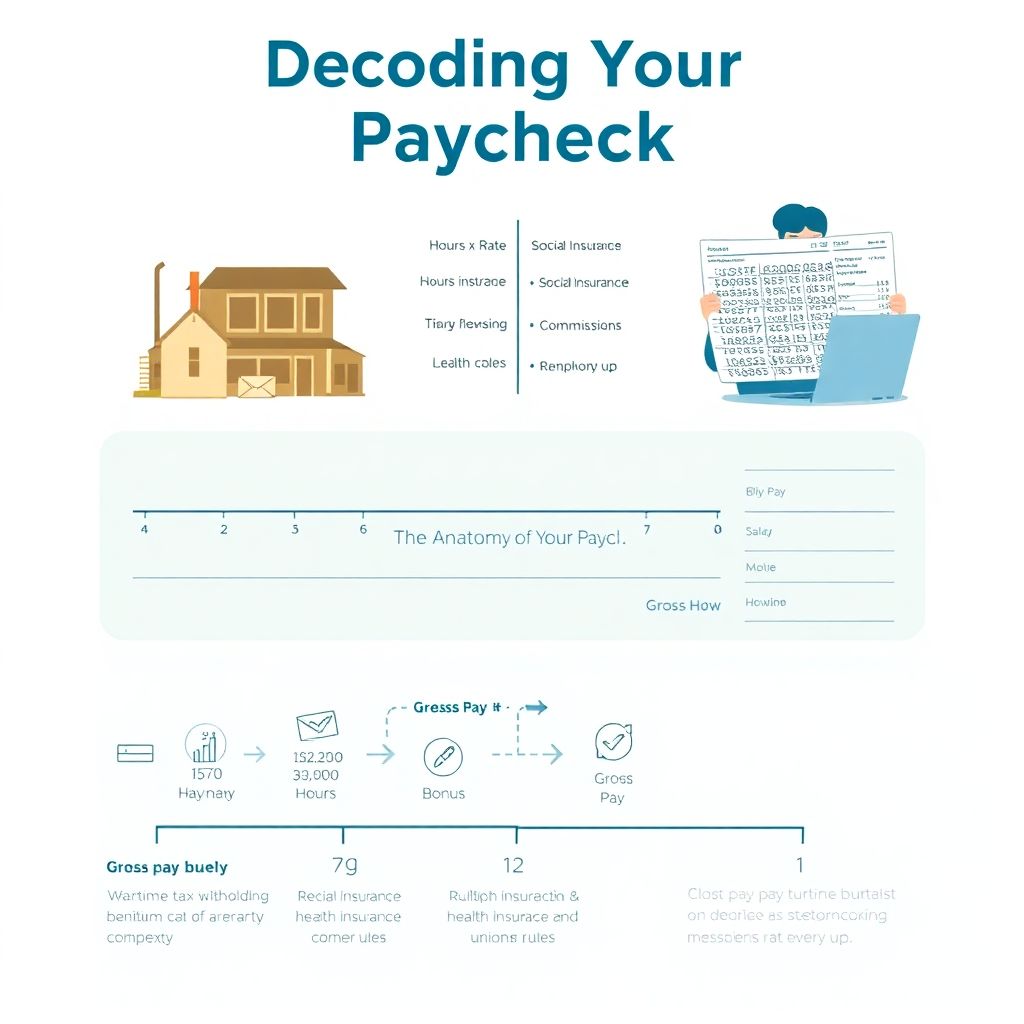
At its core, your paycheck boils down to four building blocks: gross pay, pre‑tax deductions, taxes, and net pay. Gross pay is everything you earn before anything is taken out: base salary, overtime, bonuses, commissions. Pre‑tax deductions are items like traditional 401(k) contributions or some health premiums that lower the amount of income the government can tax. Taxes are the mandatory amounts withheld for income tax, Social Security, Medicare, and possibly state or city taxes. When you use a paycheck tax calculator, it’s modeling exactly these steps: start from gross, subtract pre‑tax items, apply the tax formulas, then subtract post‑tax items such as Roth contributions or garnishments. What’s left is net pay—the number that actually lands in your bank account and determines what you can safely budget and spend.
A quick rule of thumb: if a deduction reduces both your taxes and your take‑home pay, it is usually pre‑tax; if it only reduces your take‑home pay, it’s probably post‑tax. Keeping that simple distinction in mind helps you see which items on your stub are saving you money today versus which are just bills with extra steps.
Benefits, taxes, and why “free” perks still cost something
Modern employee benefits packages blend insurance, savings, and perks, and many of them are closely tied to your paycheck. Health, dental, and vision plans are often partly paid by the employer, but your share comes out of each pay period, sometimes before tax, sometimes after. Retirement accounts, health savings accounts, and commuter benefits can reduce your taxable income if they’re structured the right way. That’s why an employee benefits packages comparison should never look only at the “salary” row; you also need to check how much of your paycheck is being redirected toward coverage, and whether those deductions are pre‑tax or post‑tax. Once you see that structure, “mysterious” line items like “HSA EE PRE” or “401K DEF” start making much more sense, and you can decide whether to increase, decrease, or redirect contributions without feeling like you’re guessing in the dark.
Put simply, most benefits are either protecting you (insurance), paying your future self (retirement and savings), or buying you convenience (like commuter passes). The stub is just the scorecard of how much you’re investing in each bucket.
Examples of implementation in real life
Let’s walk through a concrete case. Imagine Maya, a marketing specialist earning $3,000 gross each biweekly paycheck. She contributes 5% to a traditional 401(k) and pays for employer health insurance. Her pre‑tax deductions are $150 for retirement and $120 for health, leaving $2,730 of taxable income. Her employer’s payroll software then uses her W‑4 data to estimate federal withholding, adds Social Security and Medicare, plus state income tax, which together might total about $600. After those taxes, the system subtracts a post‑tax gym membership of $30 and a charity deduction of $20. Maya’s final net pay hits her account at around $2,080. When she later uses online tax filing for paycheck income, her actual year‑end tax return reconciles those estimates with reality, possibly giving her a refund if the payroll system withheld a bit too much all year.
Another scenario: Luis runs a five‑person design studio and recently shifted from doing payroll in spreadsheets to hiring payroll services for small business. Before the switch, he often miscalculated overtime and forgot to adjust deductions when people changed benefit elections, causing minor but stressful paycheck errors. With a service in place, the software automatically updates tax tables when laws change, re‑calculates withholdings every pay period, and even produces clean, readable stubs for each employee. The result is fewer “Hey, my paycheck looks off” messages in his inbox and a lot more trust from the team.
Case: decoding an unexpectedly small paycheck
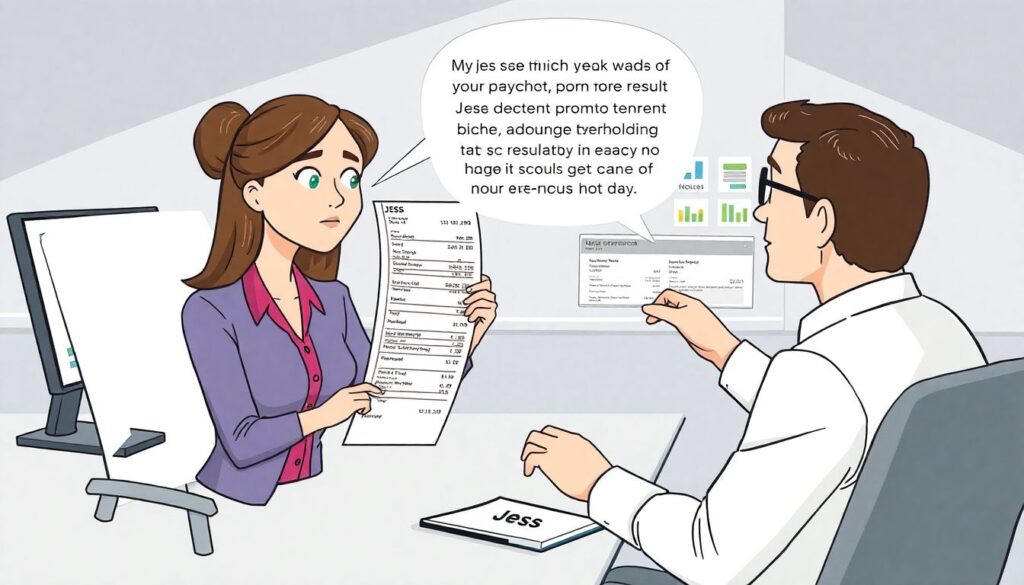
Consider Jess, who received a promotion and a raise but saw almost no change in take‑home pay on the next check. Confused, she sat down with HR to figure it out. Together they reviewed how to read your paycheck stub line by line. The raise nudged her into a higher withholding bracket, she had increased her 401(k) contribution from 3% to 8%, and open enrollment had just started a more expensive health plan. Each change was reasonable alone, but all three hit the same paycheck cycle. Once Jess saw the breakdown, she realized the raise actually was there; she had just chosen to channel most of it into savings and richer benefits. She left the meeting relieved, and decided to slightly dial back the 401(k) bump so the raise felt tangible in her monthly budget.
Moments like this are common: a “missing raise” is often just a cluster of quiet decisions finally showing up on paper.
Common misconceptions: cleaning up the myths
One widespread misconception is that the government “takes whatever it wants” from each paycheck, and that your annual tax return is a separate process. In reality, payroll follows formulas rooted in your tax forms and local laws; it’s not random. Your employer uses what you indicate on forms like the W‑4 to estimate your total yearly tax and then spreads that amount over your pay periods. If too much is taken, you get a refund; too little, and you owe. Another myth is that benefits are automatically a “bonus” with no downside. While they often provide excellent value, they can significantly reduce your net pay, especially when you opt into multiple plans at once. Even premium tools like a paycheck tax calculator can mislead you if you ignore pre‑tax contributions or forget about irregular income like bonuses or freelance work, both of which can change how much actually lands in your account.
People also tend to assume that if their friend with a similar salary takes home more, the payroll department must be making a mistake. In practice, differences in withholding choices, retirement contributions, and state or city taxes explain most of those gaps.
Myth vs. reality in benefits and compliance
Another persistent myth is that employers can structure paychecks however they like. In fact, there are strict rules around minimum wage, overtime, timing of payments, and the order in which deductions can be applied. For instance, certain garnishments and child support orders must come out before optional post‑tax deductions. Likewise, some workers believe that declining all benefits will magically “maximize” their income. While this does increase immediate take‑home pay, it can mean losing out on employer matches, tax‑favored savings, and group insurance rates that are hard to beat on the open market. Over time, skipping those options can cost far more than the few extra dollars per check you keep now, which is why thoughtful planning—and sometimes a professional employee benefits packages comparison—matters more than just chasing the biggest possible net number today.
So instead of asking, “How do I get the absolute biggest paycheck right now?” a better question is, “Which mix of taxes and benefits gives me the best long‑term outcome without wrecking this month’s budget?”
Putting it all together
Once you understand the history, structure, and typical pitfalls of modern paychecks, the entire topic stops feeling like a puzzle and becomes a manageable system. The stub in your inbox is essentially a little report: what you earned, what you chose (benefits and savings), and what the law requires (taxes and mandatory deductions). Each time your life changes—a raise, a new city, a different health plan, a second job—you can expect that report to shift as well. When that happens, don’t just glance at the net number; walk line by line through gross pay, pre‑tax items, taxes, and post‑tax deductions. Use tools like a paycheck tax calculator for quick checks, but also talk to HR or a tax professional when something looks off or you’re planning a big change. Over time, this habit turns your paycheck from something you dread opening into a dashboard you can read, question, and actually use to steer your financial decisions.
If you do that consistently, your paycheck stops being a mystery and becomes what it was always meant to be: a clear story of how your work turns into money, protection, and future security.