Why Bonds Suddenly Look Interesting Again in 2025
For years, bonds felt boring. Yields were tiny, stocks were booming, and any mention of “fixed income” made beginners tune out.
2025 — totally different story.
Interest rates are still higher than in the 2010s, governments and corporations issue new types of bonds, and digital platforms finally made bond investing accessible with a few taps. For a beginner, this is actually a pretty good time to understand what’s going on and start small.
Let’s walk through how to start investing in bonds for beginners in today’s market — without jargon overload, but с холодной головой и цифрами в уме.
—
What a Bond Really Is (and Why It Matters in 2025)
At its core, a bond is just an IOU.
You lend money to a government or a company → they pay you interest (the coupon) → at the end (maturity) they return your original amount (principal).
In 2025, two things make bonds especially relevant:
– Higher yields: After years of near‑zero rates, many high‑quality government and corporate bonds now pay 4–6% or more.
– Market volatility: Stocks are jumpy, tech valuations are debated daily, and many beginners want at least part of their portfolio to be more predictable.
Why beginners are finally paying attention
Bonds can:
– Smooth out the roller coaster of stock investing
– Provide regular interest payments you can plan around
– Give you clearer expectations on risk and return than some trendy assets
But only if you understand what you’re buying — especially now, when interest rates and inflation are still not fully settled.
—
Key Bond Concepts You Must Grasp First
You don’t need a finance degree, but you do need these four basics.
1. Yield vs. coupon
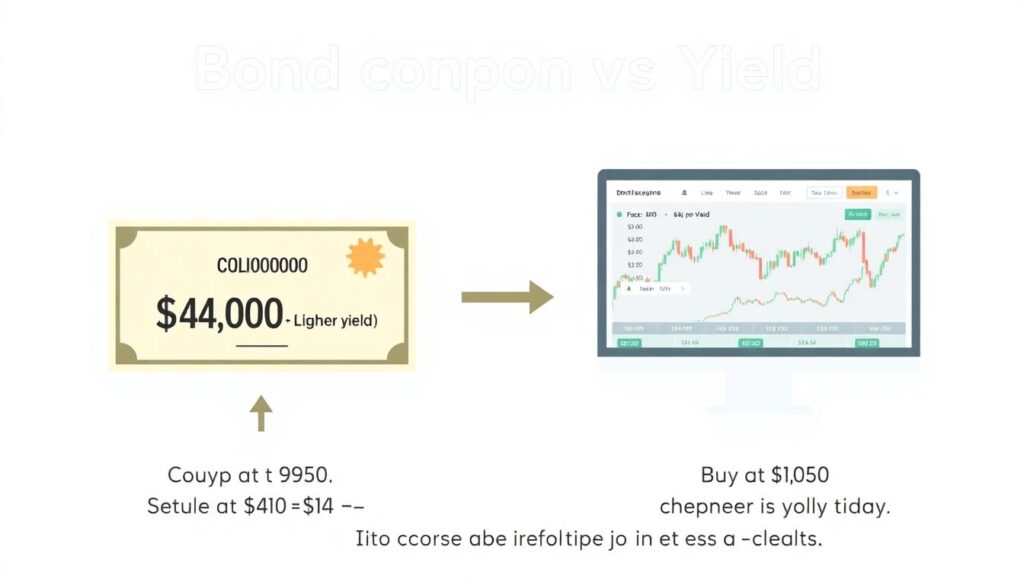
– Coupon: Fixed percentage paid on the face value of the bond (e.g., 4% on $1,000 = $40 a year).
– Yield: What you actually earn based on the *price you pay today*.
In 2025, bond prices move daily on trading platforms. You might buy a $1,000 face‑value bond for $950 or $1,050 — your true yield depends on that entry price.
2. Maturity
– Short‑term: up to 3 years
– Intermediate: 3–10 years
– Long‑term: 10+ years
Rule of thumb: the longer the maturity, the more sensitive the bond is to interest rate changes. With central banks still signaling potential adjustments, beginners often don’t need ultra‑long bonds unless they truly understand the risk.
3. Credit risk
– Government bonds from stable countries: usually lowest default risk.
– Investment‑grade corporates: solid large companies, moderate risk.
– High‑yield (junk): higher potential income, higher chance something goes wrong.
In a world where corporate defaults picked up after years of cheap money, looking at credit quality isn’t optional — it’s core risk management.
4. Interest rate risk
When rates go up, existing bonds with low coupons become less attractive → their prices fall.
When rates go down, existing higher‑coupon bonds become more valuable → prices rise.
Since 2022–2024 brought sharp rate moves, bond prices got a reality check. Entering in 2025, you’re not paying 2021’s crazy high prices, which is actually an advantage for long‑term beginners.
—
Modern Ways to Invest in Bonds as a Beginner
You’re no longer forced to call a broker and buy one single $10,000 bond. Technology changed the game.
1. Bond funds and ETFs
For most newcomers, beginner bond funds with low fees are the easiest entry point. These are mutual funds or ETFs that hold dozens or hundreds of different bonds.
Advantages:
– Instant diversification
– Low minimum investment (often just the price of one ETF share)
– Professional management
– Easy to buy and sell via regular brokerage apps
If you’re asking yourself what are the best bonds to invest in for beginners, in practice you’ll often end up choosing funds rather than individual bonds, at least at the start.
2. Digital bond platforms
Over the last few years, a wave of bond investment platforms for beginners has appeared:
– App‑based brokers offering fractional bond purchases
– Robo‑advisors that automatically allocate a portion to bond ETFs
– Platforms focusing on government and investment‑grade corporate bonds with transparent fees
They streamline bond selection with filters (maturity, yield, rating) and show you how adding bonds might affect your portfolio’s risk. For a first‑timer, this visual guidance matters more than glossy marketing.
3. Direct government bonds online
Many countries now let individuals buy government bonds directly via official websites or partner apps:
– Lower commissions than some brokers
– Very clear terms
– Sometimes tax advantages (varies by country)
In 2025, this has become a simple, conservative starting point for people who want fixed income but don’t trust flashy startups.
—
Which Types of Bonds Make Sense for Beginners in 2025?
When people search for the best bonds to invest in for beginners, they often expect a magic ticker symbol. Reality is more nuanced — it’s about categories fitting your goals and risk tolerance.
1. Government bonds as a core
Typically suitable as a foundation if you’re cautious:
– Backed by national governments
– High liquidity on modern trading apps
– Strong track record in developed markets
Good for:
Anyone who wants stability first, return second.
2. Investment‑grade corporate bonds
Issued by large, relatively stable companies:
– Higher yields than government bonds
– Still relatively moderate default risk
– Widely available through bond ETFs and mutual funds
Good for:
Beginners willing to accept a bit more risk for better income, especially via diversified funds rather than picking single issuers.
3. Short‑term and ultra‑short bond funds
These focus on bonds maturing in a few years or less. Their prices typically move less when interest rates shift.
In an environment where no one is fully sure how central banks will act in 2026–2027, many newcomers use these as “parking spots” for money they might need in a few years.
—
Modern Fixed Income Options You Should Know About
The phrase fixed income investment options for beginners now covers more than just classic bonds.
What’s on the menu in 2025
– Traditional bond ETFs and index funds
– Target‑maturity bond ETFs that behave more like a bond (they wind down and pay back principal around a specific year)
– Inflation‑linked bonds (where payments rise with inflation indices)
– Sustainable / green bond funds that focus on climate and ESG projects
Each has its own risk profile. In 2025, inflation‑linked and target‑maturity products are especially interesting because they give beginners clearer expectations: either some protection against rising prices or a defined endpoint for their investment.
—
Step‑by‑Step: How to Start Investing in Bonds in 2025
Let’s put this into a practical route you can actually follow.
Step 1: Clarify why you want bonds
Possible reasons:
– You’re tired of 100% stocks volatility
– You want a more predictable part of your portfolio
– You’re building a “buffer” to cover expenses for the next 3–5 years
– You’re preparing for a big expense (home down payment, education)
Your reason influences which types of bonds and funds are suitable.
Step 2: Pick your main channel
Today, beginners usually choose one of three paths:
– A low‑cost broker app with access to bond ETFs and funds
– A robo‑advisor that automatically adds bonds based on your risk profile
– An official government portal for buying government bonds directly
Look for:
– Clear, published fees
– Easy to understand interface
– Access to broad, diversified bond funds
Step 3: Start with diversified beginner‑friendly funds
Instead of hunting individual bonds, focus on:
– Broad government bond ETFs
– Investment‑grade aggregate bond funds (mix of government + corporate)
– Short‑term bond funds if you’re very rate‑sensitive
Many of the most reliable beginner bond funds with low fees are simple index funds tracking well‑known bond indices. In 2025, cost is still a crucial factor — every extra 0.5% fee erodes your yield significantly.
Step 4: Decide on allocation
Common simple rules:
– More years left until retirement → higher stock share, lower bond share
– Closer to goals or lower risk tolerance → higher bond percentage
You might start with something like:
– 10–30% bonds if you’re young and risk‑tolerant
– 30–60% bonds if you’re more conservative or closer to medium‑term goals
Adjust slowly, not every month. Bonds are about stability, not constant tinkering.
—
Practical Tips for Bond Beginners in Today’s Market
Tip 1: Don’t chase the highest yield you see
If something offers much more yield than everything else:
– There’s probably higher default risk
– Or longer maturity and huge interest‑rate sensitivity
– Or both
In 2025, with some stressed sectors still dealing with old debt taken during ultra‑low‑rate years, blindly chasing high yield is a common beginner mistake.
Tip 2: Look at total return, not just coupon
Your result = interest you receive + price change of the bond or fund.
Even a modest coupon can give good total return if you bought after a price drop and rates later decline. That’s why starting after the 2022–2024 bond sell‑off might quietly be an advantage for patient beginners.
Tip 3: Use bonds to match your time horizon
Approximate guideline:
– Money needed in 1–3 years → short‑term bonds or cash‑like instruments
– 3–7 years → mix of short‑ and intermediate‑term bond funds
– 7+ years → you can afford more interest rate fluctuation, consider intermediate‑term funds as a core
Matching maturity/risk to your real‑life goals is much more important than guessing the “perfect” rate forecast.
Tip 4: Prefer simplicity over exotic products
The modern market offers:
– Leveraged bond ETFs
– Exotic structured notes
– Complex hybrids mixing bonds, derivatives, and currencies
They might sound tempting in app ads, but for a beginner, they add layers of hidden risk. Sticking to plain government and investment‑grade bond funds is usually a better starting point.
—
Current Trends Shaping Bond Investing in 2025
If you’re starting now, you need to at least be aware of the bigger forces moving this market.
1. “Higher for longer” interest rate debate
Markets are still arguing: will central banks keep rates higher for longer, or start cutting more aggressively?
Implications for you:
– If rates stay high → yields stay attractive, but existing bond prices won’t jump quickly.
– If rates fall → your current bonds and bond funds may gain in value, boosting total returns.
You don’t have to predict the outcome. Instead, avoid extremes: no need to go all‑in on long‑term bonds or stay purely in cash.
2. The growth of sustainable and green bonds
More governments and companies issue green bonds tied to environmental projects. By 2025, this is no longer a niche:
– Many mainstream bond funds include a sustainable sleeve
– Dedicated green bond ETFs exist in most large markets
They can be a meaningful part of your portfolio, but still check: yield, credit rating, and fees — not just the “green” label.
3. Tokenization and fractionalization
Some platforms experiment with tokenized bonds, letting you buy tiny fractions recorded on blockchain infrastructure.
For beginners, the key point isn’t the buzzword, but:
– Are you getting fair pricing?
– Is your ownership legally protected?
– Are the assets real, regulated securities?
If the underlying is a solid government or corporate bond and regulation is clear, tokenization is just a delivery technology. Don’t pay extra fees just because it sounds futuristic.
—
Common Mistakes Beginners Make With Bonds
Learning from others’ mistakes is free — use it.
- Putting all money into one bond instead of diversifying through funds.
- Irrational fear after price drops — forgetting that a bond has a maturity date and regular coupons.
- Ignoring fees and buying high‑cost “safe” products that quietly eat your yield.
- Mixing up liquidity and safety: a safe bond can still be hard to sell quickly at a good price in stressed markets.
- Trying to time interest rates instead of building a reasonable long‑term plan.
—
A Simple Action Plan for the Next 30 Days
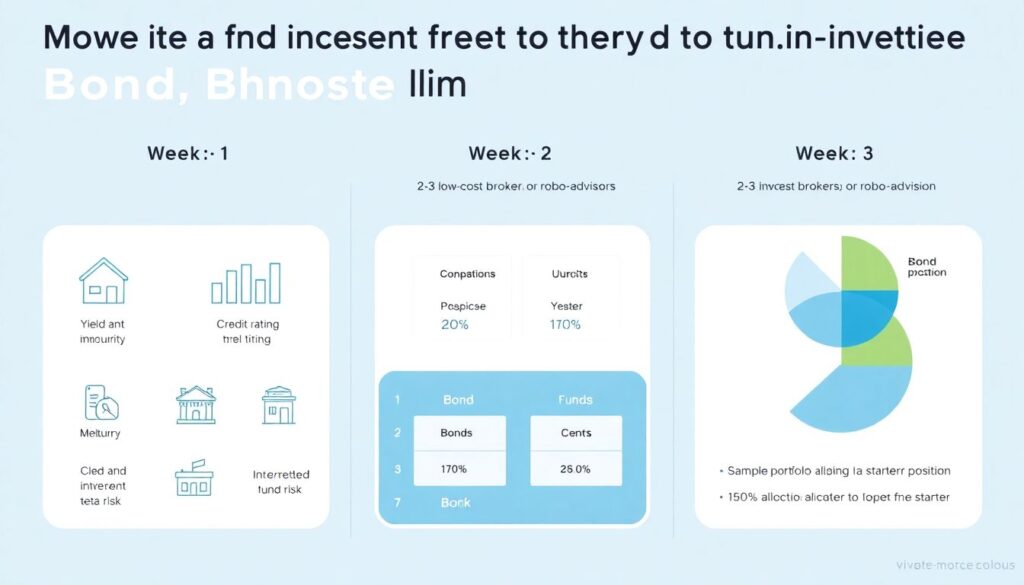
If you want to move from theory to practice without rushing:
- Week 1: Learn the basics — yield, maturity, credit rating, interest rate risk.
- Week 2: Compare 2–3 low‑cost brokers or robo‑advisors; read their bond fund lists.
- Week 3: Decide on a starter allocation (for example, 20–30% of your portfolio into broad bond funds).
- Week 4: Make a small initial investment, then set up automatic monthly contributions.
Revisit your plan every 6–12 months, not every market headline. Bonds are there to stabilize your financial life, not to give you something to check every hour.
—
Bottom Line: Bonds in 2025 Are Quietly Powerful for Beginners
In 2025, bonds finally pay meaningful income again, digital access is much better, and a wide spectrum of fixed income products allows you to tailor risk to your real goals.
You don’t need to become a bond trader. You do need:
– A basic understanding of how bonds work
– Access to low‑fee, diversified funds
– Patience to let the “boring” part of your portfolio quietly do its job
Start small, stay curious, and treat bonds as your portfolio’s stabilizer — not its lottery ticket. Over the next decade, that mindset will likely matter more than any single yield number you see on a screen today.