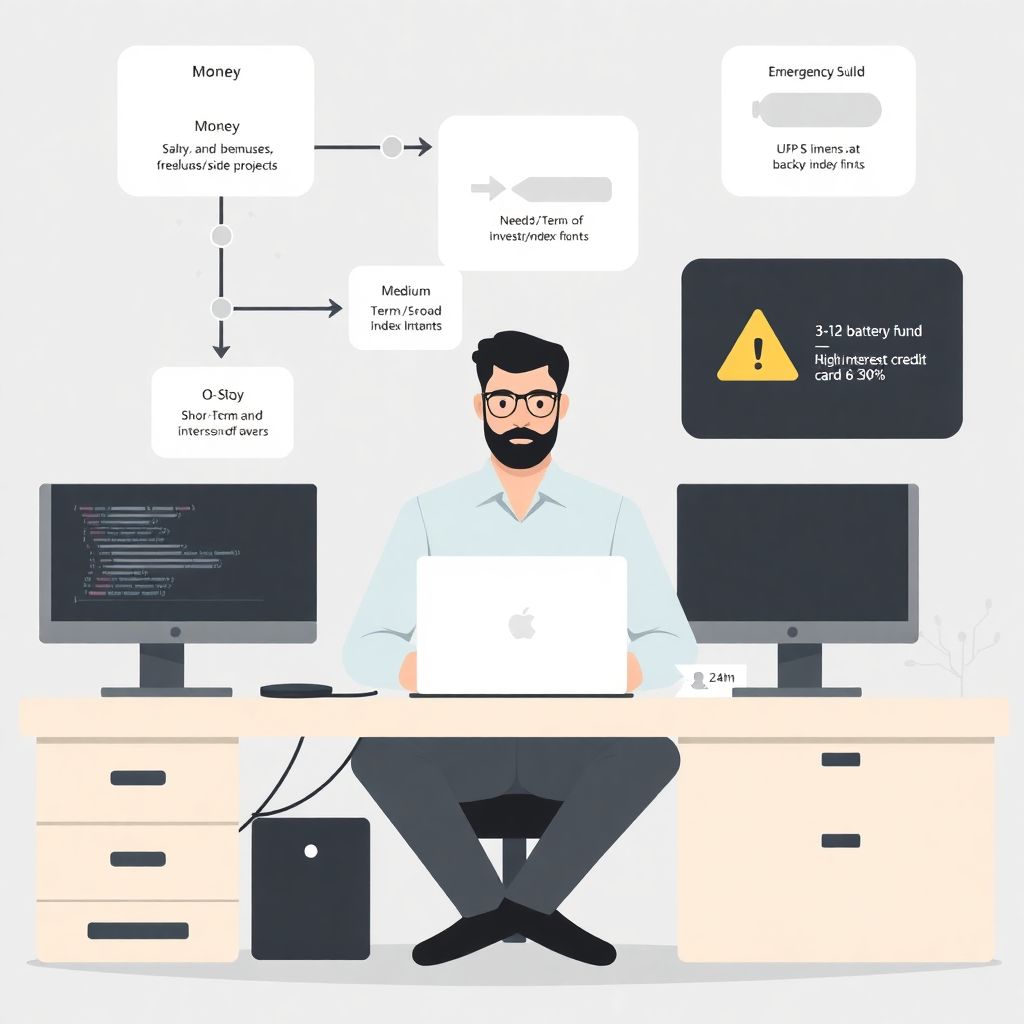
Why Personal Finance Hits Different for Engineers and Technologists
Engineers and technologists live in a weird money world.
You can earn above-average income, but:
– Your career can swing with tech cycles
– Stock-based compensation can make your pay wildly uneven
– Burnout and early career changes are common
– You might relocate between countries more than once
So personal finance for engineers isn’t just “spend less than you earn.” It’s about turning an unstable-yet-high income into long-term security and optionality: the freedom to say “no” to bad projects, toxic teams, or a career you’ve outgrown.
In other words: you want money to become your safety buffer and your leverage, not a source of stress.
—
Step 1. Get Real About Your Money Flow
Map Your Cash, Like You’d Map a System
You’d never build a distributed system without understanding data flows.
Same with your money.
1. List all income sources: salary, bonus, RSUs, freelance, side projects, consulting.
2. Separate fixed expenses (rent, utilities, debt payments) from variables (food, subscriptions, Uber, gadgets).
3. Identify “career tax”: conferences, courses, devices, relocation costs, visas, professional memberships.
Use any tool you like: a simple spreadsheet, a budgeting app, or even a text file in your repo. The format matters less than consistency.
Practical benchmark
Aim for this split as a starting point (you’ll adjust later):
– 50–60% needs
– 20–30% investing and saving
– 10–20% fun and lifestyle
If you’re early in your career or in a high cost-of-living city, it may be tight. That’s fine—what matters is that you *see* where the money goes.
Common rookie mistake
Counting RSUs, stock options, or irregular bonuses as “guaranteed salary.”
If your plan only works if your stock stays high, that’s not a plan, that’s hope. Base your required living expenses only on stable income.
—
Step 2. Build a Boring-but-Indestructible Foundation
Emergency Fund: Your Personal UPS
Think of an emergency fund as a financial UPS for your life. When the power (income) goes out, you don’t want everything to crash.
– Target: 3–6 months of core expenses if you’re early/mid-career
– 6–12 months if you’re in a niche role, on a visa, or working in a volatile startup
Park it in a high-yield savings account or other very liquid, low-risk place.
No, this is not “wasted” because it earns less than the stock market. It’s paid peace of mind and risk control.
Kill Dumb Debt First
Student loans at reasonable rates? Maybe manageable.
Credit cards at 20–30%? That’s financial arson.
Put high-interest debt payoff before aggressive investing. The “return” of not paying 25% interest is better than almost any investment.
Watch out for this trap
Upgrading everything once your salary jumps: apartment, car, gadgets, vacations. Lifestyle inflation feels harmless… until you’re making 3x your old income and somehow still living paycheck to paycheck.
—
Step 3. Design a Simple Financial System (Not a Science Project)
Your instinct might be to over-engineer your finances: 12 asset classes, intricate options strategies, daily rebalancing. Don’t.
Good financial planning for engineers is about choosing a system so simple you can run it even when you’re stressed, busy, or between jobs.
The “Buckets” Model
Split your money into clear buckets:
1. Short-term (0–2 years)
Emergency fund, upcoming big purchases (move, car, tuition, wedding).
Vehicles: cash, high-yield savings.
2. Medium-term (2–7 years)
House down payment, sabbatical, MBA, career switch.
Vehicles: conservative mix of bonds + broad stock index funds.
3. Long-term (7+ years + retirement)
Wealth building and retirement planning for engineers.
Vehicles: mostly diversified stock index funds, maybe some bonds as you age.
Assign each goal to a bucket. The timeline tells you how risky you can afford to be.
A simple rule of thumb
If you need the money in under 3 years, don’t gamble it in stocks. Volatility timelines are real; crashes don’t care about your goals.
—
Step 4. Investing 101 for Tech People (Without the Hype)
Why Simple Usually Beats “Clever”
You’re surrounded by people shilling:
– Crypto projects
– AI trading bots
– “Secret” options strategies
– Hot startup angel deals
But most data still points to something boring: over time, diversified low-cost index funds tend to beat most active traders and stock pickers.
When people talk about the best investment strategies for software engineers, they often overcomplicate things. In reality, for 90% of tech professionals, the best “strategy” is:
– Automate monthly contributions
– Use broad index funds/ETFs (global, US, or your home market)
– Keep fees low
– Don’t panic-sell in downturns
Step-by-step starter setup
1. Max out tax-advantaged accounts first (401(k), IRA, ISA, EPF, etc., depending on your country).
2. Pick 1–3 low-cost, diversified funds (e.g. global equity fund + bond fund).
3. Set an automatic monthly contribution—treat it like a bill.
4. Rebalance once or twice a year, not every two weeks.
Red flags to avoid
– Anyone guaranteeing high returns
– Complex products you don’t fully understand
– Investing based on social media trends or coworker FOMO
– Overconcentration in your own employer’s stock
Diversification looks boring… right up until a bubble pops.
—
Step 5. Handling Tech-Specific Income: Stock, Bonuses, and Side Gigs
RSUs and Stock Options: Treat Them as Risk, Not “Free Money”
If you work in tech, a big chunk of your comp might be equity.
This is both an opportunity and a risk.
Suggested rules:
– Don’t let a single company’s stock (especially your employer) become more than 10–15% of your net worth.
– Have a default policy: when RSUs vest, sell a portion automatically and move it to your diversified portfolio.
– Understand the tax impact before exercising options or selling shares.
This is one area where a good financial advisor for tech professionals can be worth the cost, because the tax and timing nuances can get messy fast.
Side Projects and Freelancing
Lots of engineers do freelance work or build products on the side. Revenue here is often lumpy.
Basic principles:
– Assume side income is temporary and unpredictable.
– Use it mainly for extra investing, debt payoff, or one-off goals—not to inflate your baseline lifestyle.
– Track taxes! Don’t get surprised by a giant bill because “it was just side income.”
—
Step 6. Career-Driven Money Planning (Your Biggest Asset Isn’t in the Market)
Your future earning power usually dwarfs your current investment portfolio, especially early in your career.
Think in Terms of “Option Value”
Money gives you the option to:
– Leave a toxic team
– Take a pay cut to switch into a new field (e.g., ML, security, robotics)
– Join a startup
– Take a sabbatical or go back to school
– Move to a different country
Design your finances to maximize this flexibility. That might mean:
– Extra savings if you’re planning a transition
– Keeping fixed expenses low so you can handle a pay cut
– Building a substantial runway before you jump into a startup
Big mistake to avoid
Tying your entire identity and income to one niche (or one company) without a backup plan. Tech moves fast; skills and roles can get commoditized. Your finances should buy you time to reskill, not trap you.
—
Step 7. Retirement Planning for Engineers Who Might Not “Fully Retire”
Many engineers don’t imagine a traditional retirement. You might picture:
– Part-time consulting
– Open-source work
– Teaching or mentoring
– Building passion projects
Still, you need math behind the dream.
Modern retirement reality
Because people in tech can burn out or switch paths early, retirement planning for engineers isn’t always about stopping work at 65. It’s about reaching *financial independence,* where working is optional.
Basic guidelines:
1. Estimate your “enough” number.
A rough rule: annual spending × 25 (based on the 4% rule) as an initial target. Adjust as you learn more.
2. Use tax-advantaged accounts aggressively.
They’re boring, but tax savings compound over decades.
3. Plan for health and geography.
Healthcare, visas, and cost of living can change massively if you move countries.
Engineers’ retirement trap
Assuming “I’ll just keep working, I like what I do.” You might. But health, industry shifts, or caregiving demands can change that. Plan for optionality, not endless grind.
—
How to Manage Money as an Engineer: A Realistic Daily/Monthly Routine
Instead of obsessing over every transaction, build a light-weight financial “maintenance loop.”
Monthly
– Check that your automatic transfers to savings/investments ran successfully.
– Glance at categories: did anything spike (food delivery, subscriptions, random gadgets)?
– Adjust only if something is clearly off.
Quarterly
– Track net worth (assets minus debts).
– Revisit goals: has anything changed (job prospects, location, family plans)?
– Rebalance your portfolio if your asset allocation drifted significantly.
Yearly
– Review compensation (salary, bonus, equity) and update savings targets.
– Reassess insurance needs (life, disability, health).
– Do a tax optimization pass (retirement accounts, charitable giving, deductions).
The goal isn’t perfection; it’s building a light habit that keeps you off autopilot.
—
Working With a Financial Advisor (Or Not)
Do You Need One?
Not everyone needs a pro, but a good financial advisor for tech professionals can be very helpful if:
– You have complex equity comp
– You’re moving across countries and tax systems
– Your net worth and options are getting large enough that mistakes are expensive
Look for:
– Fee-only or fee-based advisors (not commission-only salespeople)
– Experience with engineers and tech equity
– Clear, transparent pricing and no pressure tactics
If you don’t want an advisor, at least invest time in learning the basics and double-checking big decisions. You wouldn’t deploy unreviewed code; treat five-figure and six-figure financial moves the same way.
—
Common Money Mistakes Engineers Make (And How to Dodge Them)
1. Overconfidence in “Smartness”
“I can outsmart the market; I’m an engineer.”
The market doesn’t care how many algorithms you know. Overtrading, leverage, and speculation are where many high-IQ people blow themselves up.
2. Career Myopia

Assuming your high salary is permanent.
Layoffs, automation, and shifts in demand can hit hard. Use the good years to build buffers, not just lifestyle.
3. Ignoring “Boring” Risks
Disability insurance, health coverage gaps, inadequate emergency fund—these are the bugs that don’t show in dev, only in production.
4. Social Comparison
Comparing your finances to coworkers’ cars, houses, or “wins” on social media. You’re seeing their UI, not their backend. Focus on your system, not their screenshots.
—
Beginner-Friendly Action Plan: 7 Steps You Can Start This Month
1. Track One Month of Spending
No judgment, just measurement. Use an app, a spreadsheet, or your bank exports.
2. Set Up Automatic Transfers
On payday, auto-move:
– X% to emergency fund (until full)
– Y% to retirement/investment accounts
Automate good behavior; don’t rely on willpower.
3. Build or Top Up Your Emergency Fund
Aim for at least 1–2 months of expenses quickly, then grow it over time.
4. Tackle One Debt
Pick the highest-interest debt and attack it with any surplus cash.
5. Open or Simplify Your Investment Account
If you’re not investing yet, start with a single diversified fund.
If you have a mess of random funds, consider simplifying into a small, coherent set.
6. Set One Concrete 12-Month Goal
Examples:
– Save for a three-month mini-sabbatical
– Build a down payment fund
– Pay off a specific debt
– Reach a target net worth
7. Put a “Finance Review” in Your Calendar
Once a month, 30 minutes. Treat it like a meeting with Future You.
—
The Future of Personal Finance for Engineers and Technologists (2025 and Beyond)
More Tools, More Noise
From 2025 onward, expect:
– Smarter AI-based budgeting and robo-advisors tuned to tech careers
– Better integrations between payroll, brokerage, and tax tools
– Dashboards that automatically model vesting schedules, tax scenarios, and career changes
At the same time, there will be even more hype:
– “AI-powered trading strategies”
– Speculative assets dressed up with buzzwords
– Influencers pitching complex products to tech audiences
Your edge won’t be access to tools; it will be the ability to ignore 90% of them and stick with a simple, robust strategy.
Global and Remote Work Complexity
Remote and hybrid work are now standard, and cross-border employment is only increasing. That means:
– Multi-country tax issues for remote engineers
– Retirement accounts and benefits scattered across systems and geographies
– Currency and relocation risk becoming part of normal planning
People who learn early how to manage money as an engineer in a global context—multiple currencies, tax treaties, relocation planning—will have a big advantage. Expect more specialized services and content aimed at globally mobile tech workers.
Career Half-Lives Are Shrinking
The “half-life” of specific technical skills keeps dropping. AI, automation, and new frameworks will keep rewriting what’s “hot.” That makes solid financial habits more critical:
– You’ll likely reskill multiple times
– Income may spike and crash with role and industry shifts
– Sabbaticals and retraining breaks will be normal
Personal finance in this environment is less about hitting one magic retirement number and more about staying continuously resilient: enough savings, low fixed costs, and a portfolio designed to weather volatility.
The Constant in All This Change
Tools, platforms, and even job definitions will change. What doesn’t:
– Spend less than you earn over the long run
– Keep a buffer for when life (or the market) crashes
– Invest regularly in diversified, low-cost assets
– Protect your downside (insurance, emergency funds, skills)
– Use money to create freedom, not just consumption
If you treat your financial life the way you treat a critical production system—designed for resilience, monitored regularly, and improved iteratively—you’ll be ahead of most people in and out of tech.
And the best time to start shipping version 1.0 of your money system? This year, not “when things calm down.” They never really do.