
Why your tax return is secretly a money map
Most people treat their tax return like a horror novel: flip to the last page, look at the “refund” line, sigh with relief (or pain), and shove the whole thing in a folder. But if you learn how to read a tax return for personal finance, it turns into something very different — a map of how money really flows through your life. Your income patterns, hidden fees, tax breaks you’re missing, even evidence that your salary is growing too slowly — it’s all there, stitched into those dry-looking lines and boxes. And once you can read that pattern without fear, you can start making deliberate choices: negotiating a better salary, moving money into smarter accounts, or cutting expenses that don’t bring joy but quietly drag your finances down year after year.
Most people never get this far, and that’s your unfair advantage. If you’re willing to spend just a little time understanding your tax return to improve personal finances, you’ll see things that even some high earners ignore. You don’t need to become a tax nerd; you just need to get comfortable asking your tax return a few clear questions and understanding the answers well enough to act on them.
Getting oriented: what your tax return is really telling you
The three big stories hidden in the form
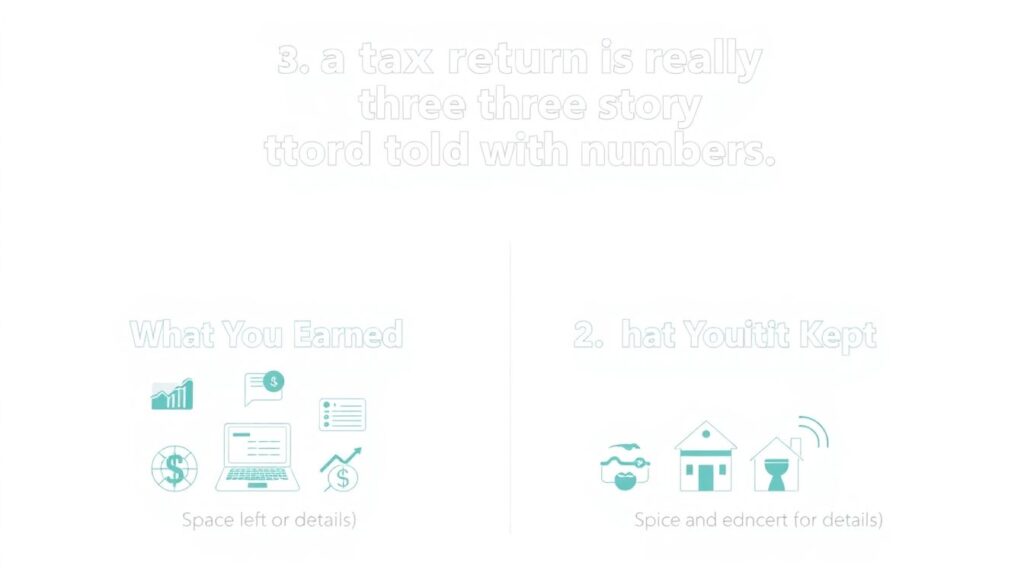
A tax return looks technical, but it’s really just three stories told with numbers. First is the “What you earned” story: wages, side gigs, investments, interest, rental income. This tells you not only how much came in, but also how diversified your money sources are. Second is the “What you kept” story: adjustments, deductions, and credits that reduce how much of your income is taxed. Here you see whether you’re actually using the legal tools designed to protect your wealth. Third is the “What you paid and why” story: your tax rate, withholdings, and any balance due or refund. This last story reveals whether your cash flow during the year was smooth or constantly fighting against the tax system. Once you see your return as these three narratives, the fear factor drops sharply, and curiosity takes over.
When you open your return, don’t try to memorize every line. Instead, skim it like a newspaper: find total income, taxable income, and total tax. These three numbers are the anchors you’ll keep coming back to while analyzing the rest.
From numbers on paper to choices in real life
Here’s the shift: your tax return isn’t a verdict, it’s feedback. Those numbers show the consequences of choices you made last year about work, saving, and spending — plus a few things that simply happened to you. Looking at them calmly lets you ask, “Knowing this, what do I want to do differently next year?”
How to connect your tax return with your money goals
Income, budgeting, and the “real” number you live on
One powerful move is to use your return as the reality check for your monthly budget. The phrase how to analyze tax return for budgeting and saving sounds intimidating, but in practice it’s straightforward. Take your total income number and divide it by 12 — that’s your average monthly gross inflow. Then look at your taxable income and divide by 12 — that’s closer to your “tax-adjusted” income, the money your lifestyle actually has to fit inside over the long run. Many people discover their monthly budget is built on their take‑home pay from a few especially good months rather than this more honest annual average. When one freelancer I coached did this, she realized her “normal” income included a big one‑off project. That insight pushed her to automate more saving in good months as a buffer instead of assuming that high number would repeat itself.
Once you see the gap between gross, taxable, and take‑home income, you can tune your budget to reality instead of hope. That’s the foundation for calm, long‑term progress.
Deductions and credits as a personal progress report
Look at your deductions and credits as signals, not mysteries. Are you taking advantage of retirement contributions, health savings accounts, or education benefits where you’re eligible? If a line is consistently zero, ask whether that reflects a deliberate decision or just inattention.
Using your tax return for real financial planning
Turning line items into long‑term strategy
Here’s where using tax return information for financial planning gets exciting. Suppose your return shows a growing amount of interest and dividends, but mostly from a regular brokerage account, not a retirement account. That might be a sign to route more of your investing into tax‑advantaged spaces so compounding works faster for you. If you see you’re consistently in a relatively low tax bracket, that could be the perfect time to convert some traditional retirement money into a Roth account, paying lower tax now to avoid potentially higher tax later. For homeowners, the breakdown of mortgage interest and property taxes can help you judge whether your housing cost is creeping out of proportion to your income, and whether it’s time to refinance, downsize, or rent out a room. Each of these moves starts with a simple observation from the tax form, followed by a conscious decision: “Do I like this pattern, or do I want to gently bend it?”
The key is to revisit these patterns yearly. Your return becomes a time‑lapse movie of your money life, not a one‑off snapshot.
Cash flow, refunds, and emotional traps
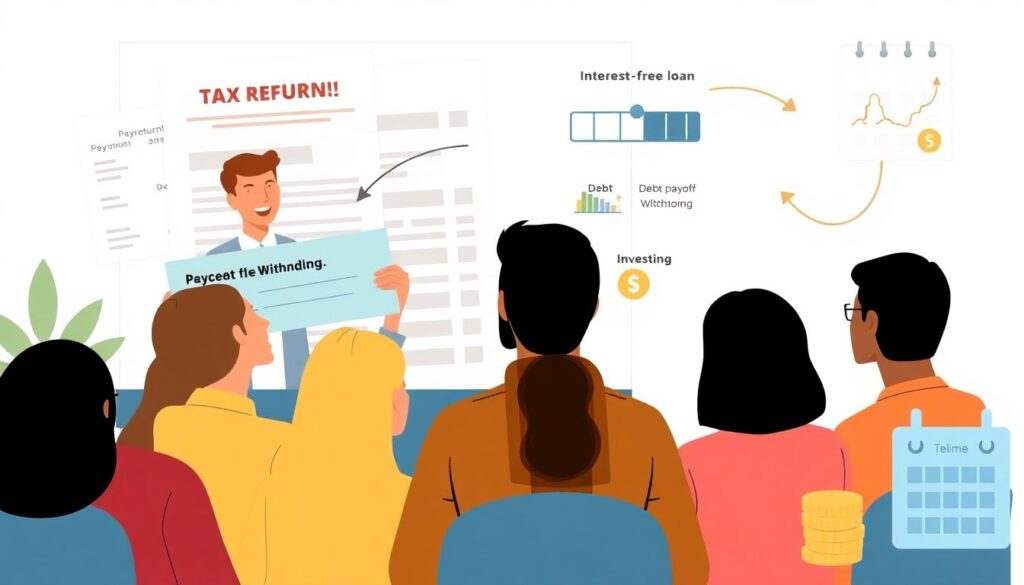
Many people celebrate big refunds, but your return can show whether that “bonus” is really just an interest‑free loan you gave the government. Adjusting your withholdings may free up cash flow for debt payoff or investing, while keeping a small cushion so you don’t end up stressed at tax time.
Real-world cases: when a tax return changes the storyline
Case 1: The “broke” engineer who wasn’t actually broke
Maya, a software engineer, felt constantly strapped for cash despite a solid salary. She did her taxes every year with software but never looked beyond the refund page. One year we sat down together and slowly walked through the full return. Her total income looked fine, but the surprise was in the “other income” and retirement sections: she had almost nothing going into her 401(k), and a large number under “taxable distributions” — she’d been pulling money out of an old retirement account to cover expenses. When we recalculated her average monthly income and looked at her rent and car payment, it was obvious: she was living like someone who expected yearly bonuses that never came. By understanding your tax return to improve personal finances, she saw her pattern clearly for the first time, cut back on housing, bumped up retirement contributions, and set a hard rule: no more early withdrawals. Three years later, her net worth chart looks completely different.
Her story shows that the problem wasn’t intelligence; it was avoidance. The tax return acted like a mirror she finally agreed to look into.
Case 2: The freelancer who turned chaos into a system

Jon, a freelance designer, used to treat taxes as an annual emergency. One April he owed more than he had in his account. That crisis pushed him to learn to read tax return forms for personal finance management instead of seeing them as punishment. He noticed two big clues: his Schedule C showed good revenue but wild swings in monthly income, and his estimated tax payments were basically guesses. We translated those annual numbers into monthly “buckets”: a fixed percentage automatically set aside for taxes from every invoice, and a target for business savings based on last year’s total expenses. Within a year, the panic disappeared. Taxes became just another bill his system already expected. Crucially, he used the same discipline to build a personal emergency fund — the same skill, applied in a different column of the spreadsheet.
His income didn’t double; his confidence did. And that made it much easier to raise prices and choose better clients.
Recommendations: building your “tax reading” muscle
Simple habits that pay off every single year
You don’t need to become a tax professional; you just need a repeatable way to check the key signals. Once a year, block out 60–90 minutes not just to file, but to reflect. Print or open your return and, with a pen or digital notes, answer a few guiding questions: What changed in my income sources compared to last year? Did my taxable income go up faster than my actual quality of life? Which deductions and credits did I use, and which look relevant but empty? Where do I feel uncertainty or discomfort reading this form? Write down any questions to ask a professional or research on your own. Over time, this becomes your personal “lab notebook” for money decisions. The science‑style mindset helps: you’re not judging yourself; you’re running experiments and observing results. Next year’s tax return becomes the data that proves whether your new savings plan, side hustle, or housing choice is really working.
When you repeat this process, your fear turns into curiosity, and curiosity quietly turns into better decisions.
From confusion to curiosity in small steps
If the form still feels overwhelming, focus on just one new section each year — for example, this year you dig into credits, next year into investment income. Gradual familiarity beats one giant, stressful cram session.
Resources and paths for ongoing learning
Where to learn more without drowning in jargon
The good news: you don’t have to figure all of this out alone. Start with the official instructions for your country’s main tax form — they sound dry, but reading just the summary sections gives you a surprisingly clear overview of what each line is trying to capture. Look for beginner‑friendly books and podcasts on behavioral finance that mention how to read a tax return for personal finance in plain language; hearing real stories makes the concepts stick. Many tax‑prep companies publish free articles and calculators that explain, in everyday terms, how different choices (like retirement contributions or freelance income) will show up on next year’s return. Community college courses on basic accounting or personal finance often include a module on how to analyze tax return for budgeting and saving, and those classes tend to be practical rather than theoretical. Finally, consider one paid session with a reputable tax professional, not just to file, but to walk through your return line by line and answer “why” questions. Think of it as a short, focused tutoring session on your own financial life.
Over a few seasons, this kind of gentle study compounds. You stop seeing the tax return as a riddle and start treating it as one of your most powerful dashboards for money decisions — a yearly snapshot that, when read with care, quietly moves you closer to the life you actually want.