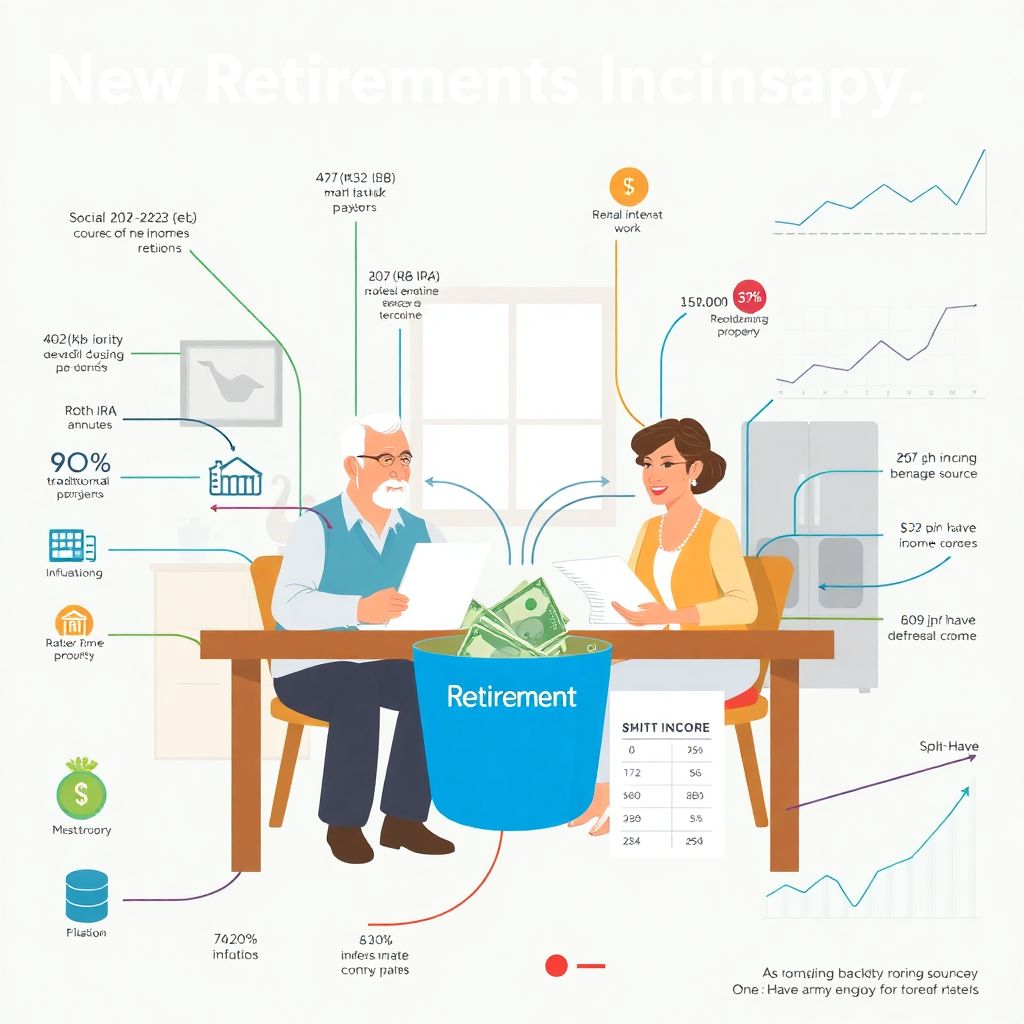
Why Your Retirement Paycheck Will Probably Have Many Moving Parts
When people say “retirement income,” they often imagine one neat monthly deposit that just appears forever. In reality, most retirees cobble together a paycheck from several different retirement income sources: Social Security, workplace plans, IRAs, pensions, savings, maybe a rental, maybe part‑time work.
Over the last few years, this puzzle has become trickier. Interest rates jumped, markets swung, and prices climbed faster than many retirement calculators expected. According to the U.S. Bureau of Labor Statistics, consumer prices rose about 6.5% in 2022, 3.4% in 2023, and were still running around the mid‑2% to low‑3% range through most of 2024. That kind of inflation reshapes what “enough” looks like, especially for people living on fixed income.
Let’s walk through what those income sources actually are, how they fit together, and how to troubleshoot common problems—without drowning in jargon.
—
The Big Five Retirement Income Sources
1. Social Security: The Government Paycheck
For most Americans, Social Security is still the foundation. In 2024, it provided about 30% of total income for people 65 and older on average, but for roughly 1 in 10 retirees it was 90% or more of their income (Social Security Administration data through 2023, trend still similar in 2024).
Two important levers matter most:
– When you claim:
Claiming at 62 permanently reduces your benefit; waiting until 70 can increase it by roughly 76% versus claiming early, depending on your full retirement age.
– How inflation affects you:
Social Security has cost‑of‑living adjustments (COLAs): 5.9% for 2022, 8.7% for 2023, 3.2% for 2024. That protected many retirees from the worst of recent inflation—but only on this slice of their income.
Short version: Social Security is inflation‑adjusted and relatively safe, but rarely enough on its own.
—
2. Employer Plans: 401(k), 403(b) and Friends
Employer retirement plans are now the main savings vehicle for many households. The Federal Reserve’s Survey of Consumer Finances (latest full data through 2022, with partial updates in 2023–2024) shows a steady shift away from pensions toward defined contribution plans like 401(k)s.
These plans matter because:
– You control contributions and investments.
– There’s often employer matching, which is basically free money.
– At retirement, they turn into a flexible but finite pot you have to manage carefully.
The challenge is turning that pile of money into a paycheck that lasts decades. That is where people start Googling “how to maximize retirement income from 401k and ira” and quickly realize there isn’t one magic rule that fits everyone.
—
3. IRAs and Roth IRAs: Your Personal Backup Plans
Individual Retirement Accounts (IRAs) and Roth IRAs often sit alongside a 401(k). Since 2022, contribution limits and income phaseouts have nudged upward almost every year to keep up with inflation, which is helpful but easy to miss if you’re not watching the IRS updates.
– Traditional IRA: Tax deduction up front (for many people), taxable withdrawals later.
– Roth IRA: No deduction now, but qualified withdrawals are tax‑free.
For retirees, these accounts become powerful tools for tax‑bracket management. Instead of blindly taking money from one account, you can mix and match withdrawals from traditional and Roth buckets to keep lifetime taxes lower.
—
4. Pensions and Annuities: “Old‑School” Guarantees
Traditional defined benefit pensions have been shrinking in the private sector for years. By 2023, fewer than 1 in 6 private‑sector workers still had access to one, though pensions remain common in government jobs.
To recreate that sense of a steady paycheck, some retirees use annuities—insurance products that turn a lump sum into guaranteed income. Rising interest rates since 2022 have quietly made new annuity payouts more attractive than they were in the ultra‑low‑rate 2010s.
They’re not for everyone, because:
– You give up liquidity.
– Products are complex, and fees can be high.
– Once you buy, undoing it is difficult or impossible.
But they can be part of the best retirement income strategies for retirees who want to convert a slice of their portfolio into “must‑have” guaranteed income.
—
5. Investments, Real Estate and Part‑Time Work
Beyond formal retirement accounts, people also rely on:
– Taxable brokerage accounts
– Rental income
– Small businesses
– Gig or part‑time work
Interestingly, post‑pandemic data from 2022–2024 show more retirees working at least a little. Labor force participation among people 65+ dipped in 2020, then edged up again through 2023–2024 as inflation bit into savings and remote/part‑time options expanded.
This kind of flexible income isn’t guaranteed, but it can take pressure off your portfolio in the first decade of retirement.
—
Necessary Tools for Making Sense of It All
What You Actually Need on the Table
You don’t need a PhD in finance, but you *do* need a few basic tools:
1. Account statements
Recent statements for your 401(k), IRAs, brokerage, bank accounts, HSAs, and pensions if you have them.
2. Social Security data
An account at SSA.gov so you can see your earnings history and projected benefits at different claiming ages.
3. A simple budget
Not a 47‑line spreadsheet. Just fixed costs (housing, utilities, insurance, groceries) and variable spending (travel, gifts, hobbies).
4. Tax basics
Last two years of tax returns plus a rough idea of your marginal tax bracket.
5. Planning support
Either software, a spreadsheet, or—if things are complex—human help. That’s where financial advisors for retirement income planning can earn their keep, especially with taxes and withdrawal strategy.
With this toolkit, you can stop guessing and start doing some real retirement income planning services for yourself, even if you eventually bring in a pro.
—
Step‑by‑Step: How to Turn Savings into a Paycheck
A Practical Process You Can Actually Follow
Here’s a straightforward way to organize your different retirement income sources.
- Define your “must‑have” and “nice‑to‑have” spending.
Housing, food, utilities, baseline healthcare, and insurance go in the “must” bucket. Travel, dining out, hobbies, gifts and upgrades sit in the “nice” bucket.
This separation is key: you want reliable income to cover must‑haves, and more flexible income (that can rise or fall) for the extras.
- List all guaranteed and semi‑guaranteed income.
That includes Social Security, pensions, any annuity payments, and maybe highly stable rental income. Compare the total to your must‑have budget.
– If guaranteed income already covers must‑haves, you’re in a strong position.
– If there’s a gap, that gap must be filled from investments or work, or closed by reducing expenses.
- Decide when to claim Social Security.
Run the numbers at 62, full retirement age, and 70 using the SSA calculator. If you’re healthy and can afford to use savings for a few years, delaying can be like buying a bigger, inflation‑protected annuity from the government.
Because COLAs have been substantial recently (especially in 2022–2023), a larger base benefit can compound into significantly more income over time.
- Choose a withdrawal strategy from your accounts.
This is where people often get stuck. There’s no perfect answer, but a few principles help:
– Spend from taxable accounts first in many cases, preserving the tax benefits of IRAs and Roth IRAs.
– Watch required minimum distributions (RMDs) from traditional accounts starting in your early 70s (age rules have recently shifted into the 73–75 range depending on birth year).
– Consider partial Roth conversions in lower‑tax years to reduce future RMDs.
This mix can be far more effective than just using a fixed “4% rule” without thinking about taxes or market conditions.
- Align investments with income needs.
You don’t need your entire portfolio sitting in ultra‑safe cash, but you also don’t want all of it in volatile stocks if you rely on it for groceries.
A common approach is to use:
– Short‑term, stable assets (cash, short‑term bonds) for the next 1–3 years of withdrawals.
– Intermediate bonds and dividend‑paying stocks for the middle years.
– Growth assets (broader stock funds) for spending a decade from now and beyond.
This “time‑segmented” view helps you ride out market dips without panicking.
- Compare income‑oriented funds and products.
If you prefer set‑it‑and‑forget‑it options, you might look at managed payout funds or target‑income funds. When doing a retirement income funds comparison, pay attention to:
– How much income they target
– How they adjust withdrawals in bad markets
– Fees and tax efficiency
These details matter more than the marketing language on the front page.
- Stress‑test your plan.
Ask: “What if inflation runs hotter than expected again? What if markets drop 20% in the first two years of retirement?” Modern planning tools—or a professional planner—can model these scenarios using historical data and Monte Carlo simulations, but you can also do a basic version by hand: cut assumed returns and raise assumed inflation modestly, then see if the plan still holds.
—
How to Maximize Income from 401(k)s and IRAs Without Burning Out Your Savings
Smart Moves, Not Magic Tricks
The question “how to maximize retirement income from 401k and ira” really boils down to balancing three forces: taxes, investment risk and longevity.
Here are focused, evidence‑based moves that have looked increasingly valuable over the 2022–2024 period:
1. Use higher interest rates to your advantage.
With bond yields rising sharply after 2022, you don’t have to lean as heavily on stocks to generate income. Short‑ and intermediate‑term bonds finally pay meaningful interest again, which can reduce the need for high withdrawal rates.
2. Be strategic about which account you tap first.
For many middle‑income retirees, a tax‑savvy order looks like:
– Interest and dividends from taxable accounts
– Principal from taxable accounts
– Then moderate withdrawals from traditional IRAs/401(k)s
– Saving Roth assets for last, or for heirs
The exact order depends on your tax bracket and whether you’re facing IRMAA surcharges on Medicare premiums.
3. Smooth taxes over time.
Rather than keeping taxable income very low in your 60s and facing massive RMDs in your 70s, some retirees benefit from filling up lower tax brackets each year with deliberate withdrawals or Roth conversions. This can increase after‑tax income over the entire retirement period, not just this year.
4. Keep an eye on withdrawal flexibility.
Instead of a rigid 4% withdrawal rule, many researchers now suggest flexible rules that adjust spending a bit in response to market performance. That small flexibility can dramatically raise the odds your money lasts 30+ years.
—
Troubleshooting Common Retirement Income Problems
“My Expenses Are Higher Than Expected.”
You’re not alone. Healthcare and housing have outpaced general inflation in many regions. From 2022–2024, medical care inflation ran persistently above core inflation in several major economies.
Possible fixes:
– Trim or refinance big fixed costs (housing, vehicles) if possible.
– Delay large discretionary projects (major renovations, big trips) until markets recover or income stabilizes.
– Consider part‑time work or consulting in the early retirement years; even modest income can take a lot of pressure off withdrawals.
—
“The Market Dropped Right After I Retired.”
This “bad sequence” risk is real. If 2022’s market volatility greeted your first year of retirement, you felt this firsthand.
Troubleshooting steps:
– Temporarily reduce withdrawals from stock‑heavy accounts; lean on cash and bonds you set aside for near‑term spending.
– Pause automatic inflation increases in your withdrawals for a year or two.
– Rebalance carefully—selling a bit of what held up (like some bonds) to buy what dropped, rather than doing the emotional opposite.
This is precisely where a pre‑planned cash bucket or bond ladder can keep you from selling stocks at steep discounts.
—
“I’m Worried I’ll Outlive My Money.”
With life expectancy improving over decades and medical advances continuing, it’s rational to be cautious. Someone reaching age 65 in the mid‑2020s has a significant chance of living into their late 80s or 90s.
You can respond in several ways:
– Base your plan on a longer horizon—30 to 35 years, not 20.
– Use partial annuitization (turning a portion of assets into guaranteed income) to cover core expenses.
– Keep at least some exposure to growth assets so your portfolio has a chance to outpace inflation over the long run.
If the math feels overwhelming, this is a good moment to consider professional retirement income planning services, even for a limited engagement.
—
“I’m Overwhelmed by Choices and Products.”
You’re not imagining it—financial products have exploded in variety over the last decade. That’s why it’s important to focus first on *goals* and *cash flows*, then on investments as tools to serve those goals.
A simple rule of thumb: if you can’t explain to a friend in one sentence why you own a product and how it fits into your plan, you may need to revisit it.
—
When to Bring in Professional Help
What Advisors Actually Do in Retirement
While it’s possible to DIY much of this, the stakes are high in retirement because you can’t easily “just work more later” if something goes wrong at 80.
Competent financial advisors for retirement income planning can help with:
– Coordinating Social Security, pensions, and withdrawals
– Tax planning and Roth conversion analysis
– Investment risk management appropriate for your time horizon
– Charitable and estate planning if that’s important to you
The key is to understand how they’re paid, what services they actually provide, and whether they’re acting as a fiduciary (legally putting your interests first).
—
Pulling It Together: Your Personal Income Mix
From Jigsaw Puzzle to Coherent Plan

Your retirement paycheck probably won’t look like your neighbor’s, even if you worked in the same building. Different savings patterns, health, family situations, and risk tolerances mean there’s no single “right” formula.
What you can do is:
– Map out every income source you have or expect.
– Decide which expenses truly must be covered no matter what.
– Use guarantees (Social Security, pensions, annuities) for those must‑haves where possible.
– Use flexible income—from investments, rentals, or part‑time work—for everything else.
– Revisit the plan annually, especially after big life or market changes.
Understanding different retirement income sources doesn’t mean memorizing product names or chasing the latest yield. It means seeing clearly how money will flow into your life after the paychecks stop—and adjusting early, while you still have options.
If you start from that perspective, you’ll be far better placed to choose the best retirement income strategies for retirees in your situation, rather than trying to squeeze your life into someone else’s template.