Historical context of side hustles
From odd jobs to digital gigs
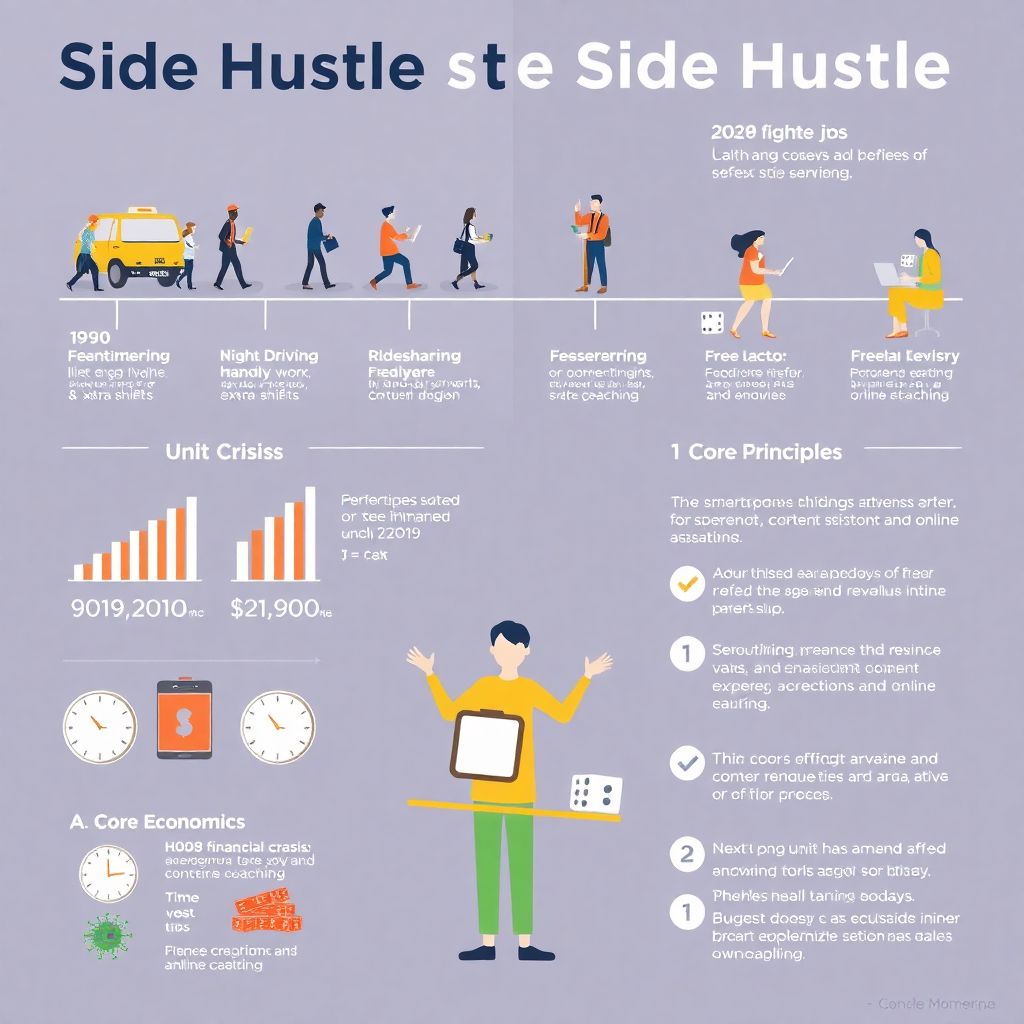
Side hustles are not some brand‑new TikTok invention. For decades people drove taxis at night, took extra shifts, or did handyman work to plug gaps in the household budget. The difference today is scale and accessibility. Instead of asking neighbors, you open an app and reach thousands of clients. That’s why the best side hustles to make extra money now tend to be platform‑based: you plug into existing demand, use built‑in payment systems, and skip a lot of old‑school logistics that used to block beginners.
After crises: why side income became normal
Two big shocks made side hustles mainstream: the 2008 financial crisis and the COVID‑19 pandemic. Job security shrank, and people realized a single paycheck is a single point of failure. At the same time, remote work tools, marketplaces, and online education exploded. Suddenly, high paying side hustles from home stopped being a rare privilege and turned into a realistic path for anyone with a laptop and decent internet. Today, extra income is less about “hustle culture” and more about risk management and financial resilience.
Basic principles of a side hustle that actually pays
Unit economics: don’t work blind
Side hustles only “pay off” if the numbers work. You want to know exactly how much you earn per hour after fees, taxes, and expenses. Many gigs look great on TikTok but collapse once you factor in software subscriptions, ad spend, or burnout. Treat every idea like a tiny business: estimate revenue, direct costs, and your time value. If your calculated hourly rate ends up below your main job or minimum wage, you’re not building a growth engine, you’re just buying yourself a stressful hobby with extra steps.
Time, energy and risk budget
Before you chase the next trendy idea, map your real constraints: available hours, mental energy, and tolerance for uncertainty. A demanding full‑time job plus kids usually rules out side hustles that require daily client calls or night shifts. In that case, slower but steadier models, like content or digital products, might fit better. Someone young with fewer obligations can afford more volatile but higher upside paths such as sales‑driven freelancing. The “best” model is the one you can execute consistently for 12–24 months without wrecking your health or relationships.
Priority checklist for choosing a hustle
1. Cash timeline. Do you need money this month, this year, or mainly for retirement?
2. Skill match. Can you leverage skills you already have, or will you spend months just learning?
3. Scalability. Is income capped by your hours, or can it grow without linear time input?
4. Platform risk. Are you building on your own audience or fully dependent on a single app?
5. Exit options. Can this evolve into a business, be automated, or sold later, or will it always be pure labor?
Comparing different approaches to extra income
Active vs passive: what people get wrong
Most side hustles are active income: you trade time for money, like freelance design, tutoring, or ridesharing. “Passive income” sounds magical, but almost all passive income side hustles for beginners are only semi‑passive: you front‑load effort, then maintain. Writing ebooks, building niche sites, or creating templates can eventually decouple time from income, but only after months of content creation, testing, and optimization. The trade‑off is simple: active models pay faster, passive‑leaning models pay slower but can compound if you stick with them.
Online vs offline vs hybrid
Offline side hustles (delivery, local services, events) are usually faster to start and easier to understand, but they scale poorly and tie you to location. Purely online gigs scale better and are easier to automate, but competition is tougher and you must learn digital skills. A hybrid approach often works best: for example, a fitness trainer can start offline to validate demand, then move to online coaching and digital programs. When you’re planning how to start a profitable side hustle online, think in phases: validate locally or manually, then gradually digitize and automate.
Practical examples and realistic paths
Fast, hands‑on hustles for immediate cash
If you need side hustles to pay off debt fast, speed beats sophistication. Ridesharing, food delivery, local moving help, or basic home repairs usually start generating cash within days. The downside is a hard cap on income per hour and strong exposure to platform rules. A more skill‑based route—like copywriting, video editing, or virtual assistance—takes longer to land the first client but can climb to a higher rate over time. The key is to avoid overthinking the first step: pick something simple, start earning, then upgrade your skill set as you go.
best side hustles to make extra money long term
For long‑term wealth building, prioritize skills with pricing power and low marginal cost. Freelance programming, UX design, marketing strategy, or analytics let you raise rates, specialize in a niche, and eventually build an agency or productized service. These are not classic “get rich quick” plays but compounding machines. Once you stabilize your client base, you can create courses, templates, or software tools derived from your expertise. This layering approach lets you convert active knowledge into semi‑passive income streams without starting from scratch each time.
Semi‑passive and asset‑building models
If you’re patient, content‑driven models can become high paying side hustles from home over a few years. Examples include niche blogs monetized with affiliates, YouTube channels, specialized newsletters, or digital product libraries. Early on, the revenue feels insultingly low compared to the effort, but as traffic and trust accumulate, each new article or video becomes an asset that keeps paying. Think of it like building a small personal media company: boring in the beginning, powerful once algorithms and word‑of‑mouth start sending you consistent targeted attention.
Frequent myths and mental traps
“Passive income is easy” and other illusions
The phrase “passive income” is heavily abused. In reality, almost every scalable side hustle demands either capital, expertise, or a lot of time. People see screenshots of big payouts and miss the years of iteration behind them. Another myth is that only “creative” people can succeed online; in practice, analytical and operational skills are just as valuable. The most dangerous illusion is expecting your first idea to explode. Most sustainable wins come from several cycles of trying, learning, and pivoting without blowing up your finances.
Myths about working from home and online success
There’s a common belief that high paying side hustles from home must be flashy—trading, crypto, dropshipping. In truth, many consistently profitable side gigs are boring: specialized bookkeeping, B2B email outreach, technical documentation, or maintenance of small business websites. What matters is solving a concrete problem for a specific audience and pricing it correctly. Instead of chasing whatever goes viral, map your skills to painful business problems. When you focus on reliability, clear deliverables, and communication, your “simple” side hustle can outperform flashier but unstable trends.
How to choose your next move
When you compare different approaches, match them to your timeline and risk profile. Need cash this quarter? Favor simple, active models. Building for the next decade? Blend a solid cash‑flowing service with one or two asset‑building experiments. The most robust strategy is to treat your main job, side income, and savings as one integrated system: your job funds experiments, your side hustle diversifies income, and your investments convert surplus into long‑term growth. That’s how side income stops being just extra cash and starts reshaping your financial future.