
Understanding What an Emergency Cash Reserve Really Is

Before getting into how to build an emergency cash reserve quickly, it helps to be clear about what we’re actually trying to create. An emergency reserve is boring money by design: it’s not for high returns, it’s for high reliability. Think of it as a personal shock absorber for job loss, medical bills, car breakdowns, or suddenly needing to move.
Financial planners increasingly separate this “safety money” from both long‑term investments and day‑to‑day spending. The goal isn’t to optimize your yield at any cost, but to maximize three things at once: speed of accumulation, safety of principal, and instant access. Everything else is secondary. When experts talk about resilience in 2025, a funded emergency reserve is usually the first metric they look at, even before retirement savings or investment performance.
—
How Much Do You Really Need – And How to Calculate It
Using Rules of Thumb vs. Customized Calculations
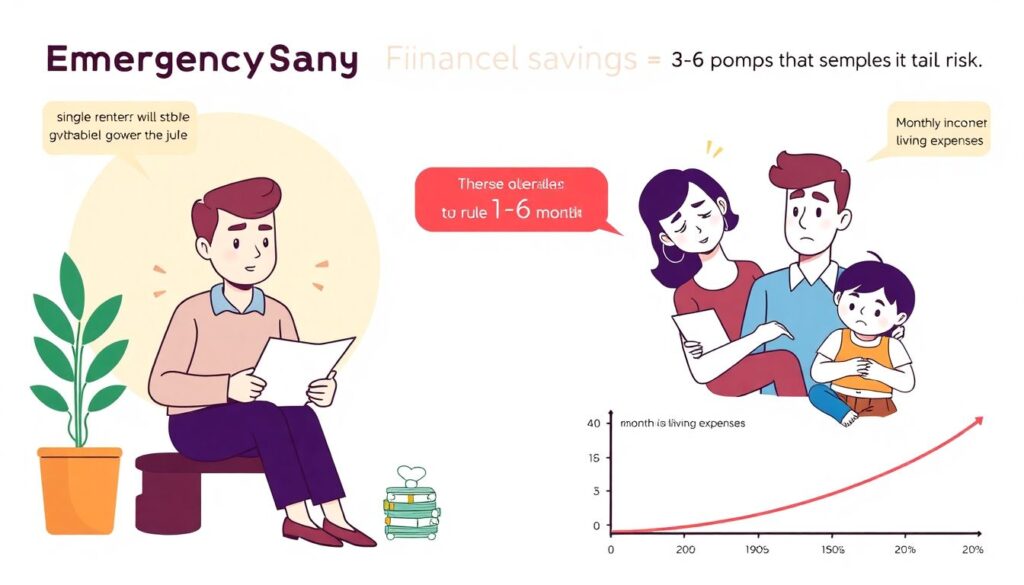
You’ll often hear the classic rule: “Three to six months of living expenses.” It’s not wrong, but it’s crude. A single renter with stable government employment doesn’t face the same risk profile as a freelancer with kids and a variable income. That’s why professionals now lean toward using more tailored tools, the equivalent of a how much emergency fund do I need calculator, that factor in job stability, dependents, debt payments, and health‑care exposure.
In practice, advisors tend to suggest a tiered goal: maybe one month of essential expenses in the next 30 days, three months within a year, and six (or more) months for anyone with irregular income or dependents. This staged approach keeps you from getting discouraged by a big number and lets you track progress in meaningful chunks. It also lets you choose different “containers” for different tiers—ultra‑liquid cash for the first layer, and slightly less liquid instruments for higher tiers.
—
Comparing Different Approaches to Building the Fund Quickly
Approach 1: Aggressive Short-Term Cash Reallocation
The fastest way to fund an emergency reserve isn’t magic—it’s temporarily redirecting cash that’s already flowing through your life. In other words, instead of treating savings as “whatever’s left,” you invert the logic and make it the first line in your budget.
1. Set a fixed weekly transfer into your emergency account.
2. Drop or pause 2–3 discretionary categories for 60–90 days (delivery, subscriptions, nonessential upgrades).
3. Route any lump sums—tax refunds, bonuses, side‑gig income—straight into the fund before you see them in checking.
Financial coaches sometimes call this a “sprint phase”: for a short period, you live a deliberately lean version of your normal life so that your buffer appears as fast as possible. The upside is speed and psychological relief; the downside is that it’s not sustainable forever. Experts recommend clearly defining an end date and a target number so you don’t experience willpower fatigue.
Approach 2: Side Income and Asset Monetization
When cutting spending isn’t enough—or already optimized—advisors point to the other half of the equation: income. Especially in 2025, with flexible remote work and gig platforms evolving, many people can create an extra $200–$500 a month without changing full‑time jobs. That alone can fully fund a basic cash reserve in a few months.
Monetizing underused assets (room rentals, unused electronics, even a second car) can be a powerful one‑off accelerator. Experts warn, however, to avoid turning your life upside down for marginal gains. The main recommendation: choose side income that won’t jeopardize your primary job performance or your health—you want a safety buffer, not burnout.
Approach 3: Automatic Micro‑Saving and Fintech Tools
A more tech‑driven approach uses automatic round‑ups, periodic sweeps, and rules‑based transfers. Modern budgeting apps can skim small amounts from each inflow and send them to your emergency account before you even see them. For people asking how to build an emergency fund fast without obsessing over every purchase, automation is often the most realistic answer.
The trade‑off here is behavioral: because transfers are small and frequent, it can take longer to feel the progress unless you set clear milestones. Advisors suggest combining automated micro‑saving with at least one bigger monthly or quarterly transfer so your brain registers that you’re actually moving the needle.
—
Where to Store the Money: Comparing Today’s Main Options
High-Yield Savings vs. Checking vs. Cash
Financial planners are nearly unanimous on one point: your emergency reserve should not live entirely in your everyday checking account. Not only is the yield usually terrible, but it’s too easy to blur the line between “available to spend” and “untouchable.” In 2025, the consensus is that the best high yield savings account for emergency fund purposes is usually:
– FDIC- or equivalent‑insured
– Accessible within 1–2 business days
– Paying a rate close to top‑tier online banks
– Sitting at a completely separate institution from your main spending account (to add friction)
Physical cash still has a role—for example, a small amount at home for power outages or card failures—but professionals rarely recommend keeping more than a few days’ worth of expenses in literal banknotes. Inflation, theft risk, and simple misplacement make large cash stashes a poor long‑term parking spot.
Money Market Funds and Short-Term Treasuries
For the second layer of your emergency reserve, some advisors now lean toward high‑quality money market funds or short‑term Treasury bills, especially in higher‑rate environments. These options can offer a bit more yield than standard savings accounts while staying relatively liquid.
The catch is that they’re not quite as instantly accessible as a simple online savings account, and values can theoretically fluctuate. For that reason, most experts recommend a hybrid structure: core emergencies covered by a high‑yield savings account, and deeper or longer emergencies covered by money markets or Treasury ladders that can be liquidated within a few days if needed.
Digital Safety vs. Physical Safety
When deciding where to keep emergency cash reserve safely, two types of risk matter: financial risk (loss, fraud, bank failure) and operational risk (not being able to access funds when you need them). In 2025, online banks and fintech platforms are largely mature, but advisors urge customers to double‑check deposit insurance, understand transfer times, and keep updated contact details.
Practically, this means: use insured institutions, enable two‑factor authentication, and keep a small “bridge amount” of emergency cash somewhere physically accessible in case of payment‑system glitches. This layered approach balances modern convenience with old‑fashioned redundancy.
—
Pros and Cons of the Main “Technologies” and Tools
Budgeting Apps and Automation Platforms
Fintech has turned classic budgeting into something more dynamic: automatic categorizations, push notifications, and visualization dashboards. For people looking for tips to save money quickly for emergency fund goals, these tools can show exactly where leaks are happening and how small changes accumulate over time.
Pros:
– Real‑time visibility into spending patterns
– Easy rule‑based auto‑saves (“whenever I get paid, move 10%”)
– Behavioral nudges that reinforce good habits
Cons:
– Over‑reliance on apps can lead to “set and forget” without reflection
– Some tools push credit products or investments that don’t fit short‑term safety goals
– Data privacy and security considerations if you connect multiple accounts
Experts generally advise using apps as decision aids, not decision makers. They’re excellent for tracking and automation, but the strategy—how much to save, where to store it—still needs clear human judgment.
Online-Only Banks and Neobanks
Online‑only banks popular in 2025 often offer attractive rates, low fees, and slick interfaces. They’re a strong candidate when you search for the best high yield savings account for emergency fund purposes. Many allow you to create sub‑accounts or “buckets,” so you can visually separate your emergency reserve from other savings goals.
On the downside, some neobanks have limited customer service, unclear paths for large withdrawals, or changing terms. Advisors suggest a quick due diligence checklist: confirm insurance coverage, look up complaint histories, and test a transfer before trusting them with your full reserve. Stability and clarity matter more here than an extra 0.10% yield.
Traditional Banks and Credit Unions
Traditional institutions still hold a place in emergency planning, especially for those who value in‑person service or immediate cash access. Credit unions in particular can offer competitive rates while providing a more community‑oriented experience.
The drawback is that many brick‑and‑mortar banks lag behind on interest rates and digital features. Experts often recommend a combination: keep a basic buffer at your local bank for instant ATM access, while holding the bulk of your emergency savings in a higher‑yield online account.
—
Practical Steps: A Structured, Fast-Track Plan
A Simple 5-Step Roadmap Most Experts Agree On
If you want a clear, actionable structure rather than vague inspiration, many financial planners would outline something like this:
1. Define the target. Use a realistic estimate of monthly essentials—rent/mortgage, food, utilities, minimum debt payments, insurance—and multiply by 1, 3, and 6 to create staged goals.
2. Create a separate home for the fund. Open a dedicated high‑yield savings account, ideally at a different bank than your daily checking, and label it explicitly as “Emergency Only.”
3. Set an automatic transfer. Start with a weekly or bi‑weekly amount that feels slightly uncomfortable but sustainable during your “sprint phase.” Increase it with every raise or windfall.
4. Cut selectively, not randomly. Identify the 2–4 categories that give you the least long‑term satisfaction and temporarily reduce them, rather than starving every part of your life equally.
5. Review and adjust quarterly. Each quarter, check your progress, adjust contributions, and decide when to move from speed mode to maintenance mode.
This structure answers the underlying question of how to build an emergency fund fast without oscillating between extremes. You’re not trying to be perfect; you’re trying to be systematized and consistent.
—
Expert Recommendations on Strategy and Mindset
What Advisors Emphasize in 2025
Financial planners, coaches, and behavioral economists broadly converge on a few themes:
– Speed over optimization at the beginning. In the first phase, getting to one month of expenses matters more than squeezing out an extra 0.5% interest. Once you have that base, you can refine your account choices.
– Separation is non‑negotiable. The emergency reserve must be psychologically and practically distinct from spending and investing accounts. Naming conventions, separate institutions, and even hidden balances inside apps all serve that purpose.
– Avoid using credit as Plan A. Advisors see over‑reliance on credit cards or personal loans as a common failure mode. Credit can function as a *back‑up to cash*, but it should never fully replace it, because credit limits can be cut right when you need them most.
– Protect the fund once it’s built. Experts urge clients to treat any withdrawal as a temporary break‑glass measure that must be followed by a “rebuild plan” as soon as the crisis passes. Without that discipline, the fund slowly erodes into lifestyle spending.
Professionals also remind clients that an emergency reserve is not a moral judgment on their financial worth; it’s simply a risk‑management tool. Viewing it like home or car insurance—mundane but essential—reduces shame and helps people take steady action.
—
Current Trends and Emerging Practices in 2025
Hybrid Cash Structures and “Resilience Buckets”
In 2025, instead of one monolithic emergency fund, many advisors now talk about layers or buckets of resilience:
– Layer 1: Instant cash (checking + a bit of physical cash)
– Layer 2: High‑yield savings at a reputable online bank
– Layer 3: Near‑cash investments (money market funds, short Treasuries)
This structure acknowledges that not all emergencies have the same size or time horizon. It also allows you to chase slightly better yields on the outer layers without compromising core accessibility.
Better Tools for Personalization
The tools used to estimate emergency‑reserve needs are getting more nuanced. What once was a generic spreadsheet is now often a guided digital questionnaire that functions like a built‑in how much emergency fund do I need calculator. These tools can incorporate industry‑specific job risk, health‑care volatility, and even local cost‑of‑living shocks.
As personalization improves, the old “3 to 6 months for everyone” mantra is quietly fading. Instead, you see tailored targets: maybe 2–3 months for a dual‑income, no‑kids household in a stable industry, and 9–12 months for a solo entrepreneur with volatile project work.
Growing Focus on Behavioral Design
Another major trend is attention to behavioral design: how accounts, apps, and even statements are structured to support good decisions under stress. For example, more platforms allow you to hide certain balances from your default view, making it easier to leave your emergency fund untouched until it’s truly needed.
Coaches also incorporate scripted rules: “I only touch the emergency reserve when an expense is (1) urgent, (2) necessary, and (3) unexpected.” By clarifying the definition upfront, you reduce arguments with yourself later about whether a last‑minute vacation counts as an emergency.
—
Putting It All Together
When you strip away jargon, building an emergency cash reserve quickly is about deliberate trade‑offs for a limited period. You intentionally channel more of today’s comfort into tomorrow’s security, using simple systems and reliable tools rather than willpower alone.
If you combine an honest target, a dedicated high‑yield account, modest but automatic transfers, and a short “sprint phase” of spending cuts or extra income, you can typically reach a meaningful buffer far sooner than it seems at first glance. After that, you shift from sprinting to maintaining, let compounding interest do quiet work in the background, and know that the next surprise life throws at you won’t instantly turn into a crisis.