
Why “No Blueprint” Budgeting Even Makes Sense
Most guides on money start with rigid charts and rules, but real families rarely fit into neat categories. One month your car breaks down, the next month your kid needs braces, and suddenly that perfect spreadsheet looks like fiction. “Family budgeting without a blueprint” means you treat the budget as a living system instead of a sacred document. Think of it like a map sketched in pencil, not carved in stone. In practice, this approach accepts messy data, inconsistent income and emotional spending, then builds habits around reality. The analytical part is not in strict formulas, but in regularly reviewing what actually happened and adjusting fast, instead of blaming yourself for “failing” a plan that never matched your life.
Key Terms: Budget, Buffer, Buckets (Plainly Defined)
To keep the conversation concrete, it helps to pin down a few terms. A “budget” here is not a static table; it is a rolling forecast of money you expect in and out over the next 30–90 days, updated weekly. A “buffer” is cash that sits between you and chaos: at least one week of typical expenses parked in a separate account so surprises do not wipe you out. “Buckets” are labeled flows of money, whether you use bank sub‑accounts or simple notes: food, housing, mobility, kids, fun, long‑term goals. In a no‑blueprint setup, these buckets flex constantly, but the labels stay stable, so you can still compare months and actually see patterns instead of raw noise.
Simple Diagrams You Can Picture, No Spreadsheets Needed
Imagine a diagram made of three concentric circles. The inner circle is “non‑negotiables”: rent, basic food, medicines, minimum debt payments. The middle ring is “negotiable but important”: education, better groceries, kids’ activities. The outer ring is “optional”: streaming, cafes, gadgets. When money is tight, you shrink the outer ring first, then the middle; the inner ring is protected. Another mental picture: draw a horizontal line as your month, then mark paydays as vertical bars. Between bars you sketch peaks where expenses cluster, like the first‑of‑month rent spike. Even as a quick scribble on paper, this timeline diagram shows why you may feel “broke” mid‑month while still being fine on average, which is critical for realistic family budgeting tips that do not pretend cashflow is smooth.
Case Study 1: Freelance Income and Chaotic Months
Lena and Mark have two kids and wildly irregular freelance income. Every attempt at a rigid family budget planner failed by week two, because payments slipped and gigs moved. They dropped the detailed monthly blueprint and switched to a 10‑day rolling view. Their only rule: the buffer account must always cover at least the next 10 days of basics from that inner circle diagram. Every Sunday they list expected income and fixed bills until the next check, then estimate food, fuel and school costs. If the buffer falls short, they immediately cut from the outer ring, often cancelling entertainment first. This micro‑horizon budgeting calmed their anxiety more than any polished spreadsheet because decisions matched the timing of actual cash.
How This Differs From Classic Budgeting Systems
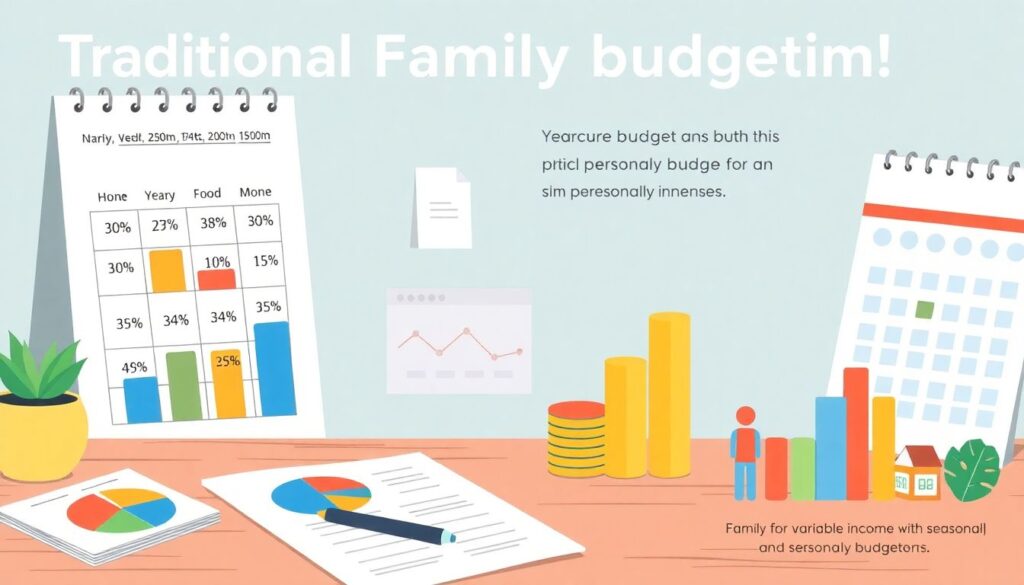
Traditional advice on how to create a family budget usually starts from a yearly plan, then breaks it into tidy monthly categories based on fixed percentages, like 30 percent housing or 15 percent food. That works if income and expenses are both stable, but families with variable pay, seasonal costs or medical issues find that such formulas crumble quickly. The no‑blueprint approach starts from volatility, not from averages. Instead of locking in category caps for the year, you keep fixed rules only for process: when you review, in what order you cut, how much buffer you must keep. In other words, the structure is in the habits, not in the initial numbers, which makes it more robust when reality keeps changing under your feet.
Case Study 2: Middle‑Class Family, Hidden Leaks
Another example: a supposedly “comfortable” household with two salaries kept wondering why savings never grew. They had a fancy household budget template downloaded from the internet, filled once and then ignored. When they tried a no‑blueprint review, they started by tracking only three buckets for a month: food, mobility, and “micro‑spends” under ten dollars. The analytical twist was brutal honesty. They printed their card statements and highlighted every snack, app purchase and quick taxi. In a hand‑drawn bar chart, each bar was a category total, and the micro‑spends towered over everything. Instead of redoing the entire template, they set a simple weekly cash cap for this one leak. No complex plan, just one high‑impact constraint tackled at a time.
Definitions in Context: Needs, Wants and Emotional Spend

“Need” is any expense where not paying creates immediate health, legal or safety risks for your family. “Want” is everything else, even if it feels important in the moment. But emotional spending blurs these lines; it is when you buy to relieve stress, prove love or imitate peers. Analytical family budgeting without a blueprint accepts that emotions drive many transactions and designs checkpoints instead of bans. For instance, you can define a “cooling‑off rule”: any online purchase above a certain amount waits 24 hours. On a notional diagram, every want sits behind this 24‑hour gate, while needs bypass it. You are not policing yourself constantly; you are moving friction from willpower to structure, which is more sustainable.
Lightweight Tools Instead of Rigid Templates
Many families bounce between elaborate Excel files and complete chaos. A middle path is using minimal tools that enforce visibility without demanding perfection. For some, the best budgeting apps for families are those that do just two things well: automatic categorisation and shared access between partners. Others prefer a basic notes app and bank push‑notifications. The tool is less important than the review rhythm: you agree, for example, that every Thursday night you glance at total spend in each main bucket, not to judge, but to nudge the rest of the week. In this context, even a rough household budget template becomes useful if it is small enough to be revisited weekly and flexible enough to tolerate mis‑categorised or missing data.
Case Study 3: Single‑Income Household and Debt Pressure

Consider a single‑income couple with two small children and significant credit card debt. Classic advice pushed them toward strict envelopes and detailed logs, which they abandoned within a month. Shifting to a no‑blueprint framework, they first mapped every debt visually as a staircase, each step a card balance. Next, they agreed that any extra income automatically attacked the smallest step until it disappeared. Day‑to‑day, they made just one operational rule: total discretionary spending for the week must stay below a number they chose together on Sunday, based on current cash. They did not label every coffee, but they watched one rolling figure. Within a year, four of seven debt “steps” were gone, not because of perfect tracking, but because of consistent, small constraints.
Building Your Own Adaptable Family Budget
If you hate spreadsheets, start your own system with a pen, paper and phone banking app. Draw the three circles of non‑negotiable, negotiable and optional expenses, then place your real bills into them. Sketch a 30‑day line and mark when money actually arrives. Now you have a raw map of pressure points. From there, pick only two numbers to track weekly: current buffer size and total optional spending so far. These two metrics act like vital signs for your money system. Over time, you can layer in more detail or migrate to a digital family budget planner, but only if it clearly answers questions you already ask yourself, like “Can we afford this trip without touching rent money?” instead of creating new complexity.
family budgeting tips That Actually Survive Real Life
Resilient family budgeting tips share a few traits. They are small enough to remember, tested against your actual bank history, and designed to fail gracefully. For instance, a rule like “We always keep one rent payment ahead” might take months to reach, but it dramatically reduces stress once achieved. Another habit is reviewing the last ten purchases together without blame, just curiosity: which of these truly improved our month? On an imaginary scatterplot, each purchase has a cost on one axis and “joy” on the other; the low‑joy, high‑cost dots are your prime targets. By focusing on patterns, not perfection, you can manage money with an honest, adaptive system rather than chasing an idealised blueprint that only exists in textbooks.