Why budgeting for back to college is a systems problem, not just “spend less”
Budgeting for back to college is essentially about designing a small personal finance system that must stay stable under stress: irregular income, academic deadlines, social pressure and rising prices. Instead of thinking “I’ll just try to spend less”, it is more productive to treat your money like a project with inputs, outputs, constraints and risk factors. This shift in mindset helps avoid chaotic spending in the first month of the semester followed by survival mode for the rest. A structured approach also makes it easier to compare different strategies: strict envelope budgeting, flexible zero-based planning or a hybrid method driven by automation and analytics through apps and your bank’s tools.
Step-by-step framework: building your back to college budget planner
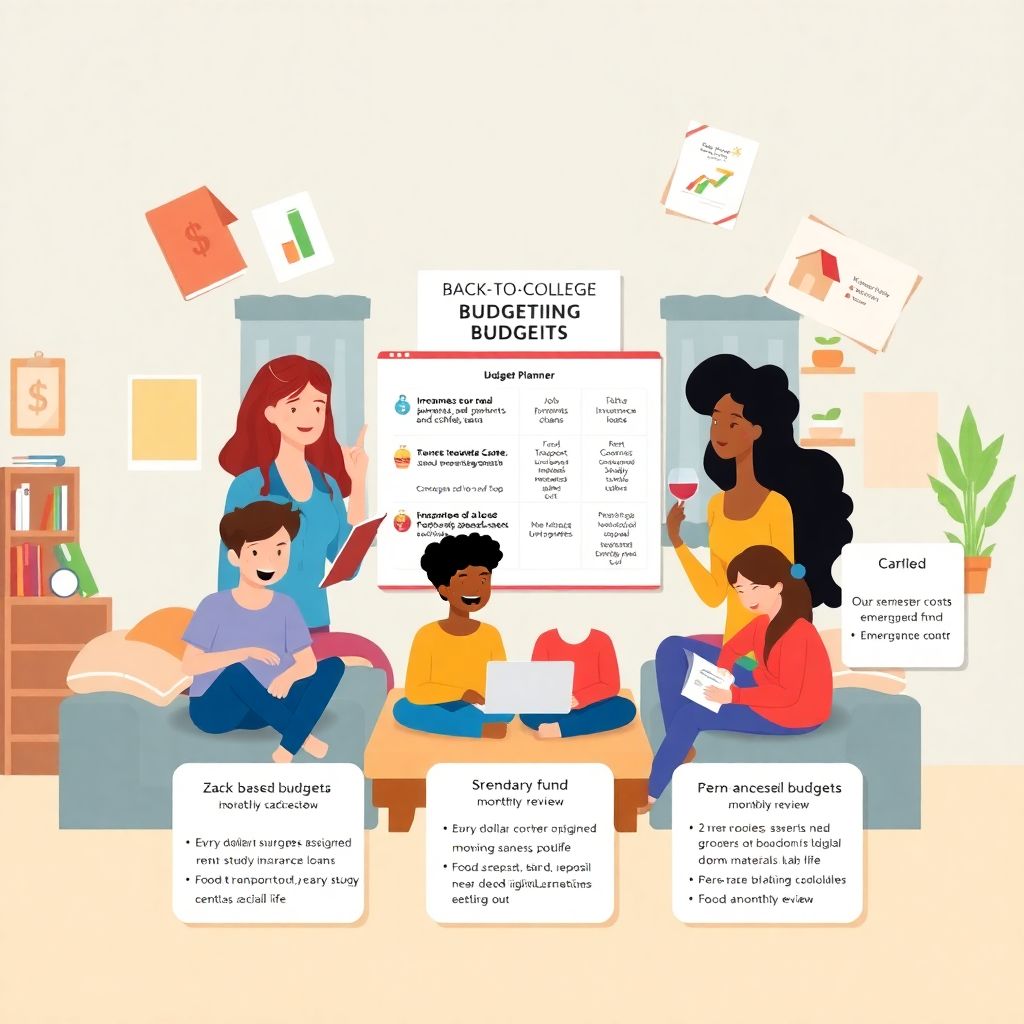
The most practical way to start is to assemble a back to college budget planner as if you were designing a simple financial model. Instead of randomly logging expenses, build a repeatable workflow: define income sources, categorize fixed and variable expenses, simulate worst-case scenarios and set hard spending caps. A basic outline could look like this:
1. Map all income streams (job, parents, scholarships, loans).
2. List non-negotiable fixed costs (tuition portion you pay now, rent, insurance, phone).
3. Estimate variable costs (food, transport, study materials, social life).
4. Add one-off start-of-semester costs (moving, deposits, cheap dorm essentials for college students, lab fees).
5. Create a realistic emergency buffer for medical, travel or equipment failures.
6. Assign spending limits to each category and track against them weekly.
7. Review and adjust at the end of each month using transaction data, not memory.
Following this sequence converts vague intentions into a concrete control process you can iterate on over the semester instead of guessing.
Approach 1: Strict zero-based budgeting – maximum control, high maintenance

Zero-based budgeting assumes that every unit of income is allocated to a specific purpose before the month starts, resulting in a balance of zero once all categories are assigned. For college use, it means you decide in advance exactly how much goes to rent, groceries, transportation, textbooks, digital subscriptions and discretionary categories like eating out. This approach minimizes idle cash that tends to “evaporate” on impulse purchases, and it is especially powerful if you rely heavily on financial aid and student loan options for college, because it prevents over-spending borrowed funds on low-priority items. The trade-off is maintenance overhead: you must reconcile transactions frequently, adjust for micro-changes and accept that this method can feel restrictive if you have volatile income or many social commitments that are hard to predict.
Approach 2: Percentage-based budgeting – simpler rules, less precision
Percentage-based budgeting uses allocation ratios instead of hard amounts. A popular structure is to route fixed proportions of your monthly inflow into categories like 50% needs, 30% wants and 20% savings or debt repayment, but you can refine this further for the college context. For instance, you might set 40% for housing and utilities, 20% for food, 10% for transportation, 10% for academic costs, 10% for social and 10% for reserves. The benefit is operational simplicity: every time money enters your account, you apply the same rule without recalculating from scratch. This technique pairs well with automation tools in online banking and budgeting apps and is much easier to sustain over multiple semesters. However, it can obscure granular realities; if your rent suddenly spikes or you add an extra course with lab fees, those fixed percentages may underfund essential categories unless you periodically recalibrate the ratios based on updated cost data.
Approach 3: Envelope or category caps – tangible constraints and behavioral control
The envelope method, whether implemented with physical cash or digital categories, sets hard ceilings on each spending group. Once the money in a category is gone, spending stops until the next cycle. For students, this technique is particularly effective for high-risk domains like dining out, rideshares, snacks and online shopping, where small transactions accumulate rapidly. Digital “envelopes” integrated into a back to college budget planner allow you to assign caps to each category and track in real time via smartphones, which introduces immediate feedback loops when you approach a limit. This approach is excellent at preventing overshoot in nonessential spending, but it can be brittle when unexpected academic or health costs arise; if you do not carve out a contingency envelope, you may be forced to raid other categories, effectively breaking the method’s behavioral constraints and undermining its impact.
Integrating banking tools: accounts, automation and cash-flow management
Your budgeting architecture strongly depends on how you configure your bank accounts and payment instruments. Many institutions promote the best student bank accounts for college budgeting with features such as no-fee checking, automatic categorization of expenses, sub-accounts or “spaces”, and usage analytics. Strategically, separating your main checking account from a savings or reserve account lowers the risk of unintentionally spending your emergency funds. Setting up automated transfers right after each deposit enforces your chosen budgeting approach, whether zero-based or percentage-based. For instance, you can auto-route a designated share into a “Books & Materials” sub-account at the start of each term. Neglecting the infrastructure side and using only a single all-purpose account increases cognitive load: you must manually track what portion of your balance is truly free versus already committed to rent, utilities or upcoming tuition installments.
Cost structure analysis: textbooks, housing and dorm setup
An often underestimated element is the initial cost of re-entry each semester, when outflows peak before routines stabilize. Performing a cost structure analysis helps identify which items are one-time, recurring or substitutable. For example, textbooks may be replaced by rentals, used copies or digital versions, and certain dorm items can be shared among roommates. Building a list of cheap dorm essentials for college students, such as basic kitchen tools, storage solutions and lighting, lets you focus on functional rather than decorative acquisitions and avoid overpriced bundles marketed for freshmen. Similarly, housing choices have long-term budget impact: an apartment farther from campus with lower rent but higher transport costs may or may not be cheaper overall than an on-campus dorm, depending on your schedule and access to public transit. Treating these decisions as optimization problems, not last-minute purchases, reduces structural overspending.
Financing strategy: scholarships, aid and debt risk
Revenue planning matters as much as expense control. Mapping all scholarships, grants, work-study arrangements and part-time jobs forms the baseline, but you need to integrate financial aid and student loan options for college into the same model. Loans shift current affordability at the cost of future cash-flow constraints through repayments and interest accumulation, so they should be treated as temporary income with a long-term liability. A prudent strategy is to simulate post-graduation monthly payments under different borrowing scenarios to understand their eventual budgetary impact. Overreliance on loans for lifestyle upgrades rather than academic necessities is a recurrent error; distinguishing between financing education itself and financing consumption makes it easier to maintain discipline. Whenever possible, direct at least a small portion of current income toward reducing future borrowing, even if the amounts seem modest during the semester.
Error patterns and risk mitigation for first-time budgeters

New students often repeat a similar set of mistakes that can be mitigated through early awareness and simple safeguards. One typical issue is underestimating variable expenses such as food outside the dining hall, unplanned club fees and transportation surcharges during high-demand periods, which leads to liquidity shortages mid-month. Another recurring error is failing to account for billing cycles: a subscription or utility bill may coincide with exam weeks, when income from part-time work is lower due to fewer hours. Additionally, many underestimate the psychological impact of peer comparison and social pressure, especially in the first semester; this can drive spontaneous spending that deviates from any rational budget. Establishing predefined decision rules—such as a mandatory 24-hour delay before major discretionary purchases—functions as a control mechanism against impulse-driven deviations.
Practical money saving tips for college students on a budget
Efficiency improvements in routine behavior often produce more savings than extreme deprivation. Instead of eliminating all social or leisure spending, look for substitution and aggregation tactics: cook in batches with roommates instead of ordering individually, buy second-hand equipment when acceptable from a reliability standpoint, and leverage campus resources such as printing quotas, software licenses and gym access that replace external paid services. Tracking recurring micro-expenses like premium app subscriptions, extra cloud storage or specialized streaming services can reveal hidden drains that add little marginal value to daily life. At the same time, systematically using student discounts and free campus events lowers entertainment costs without reducing engagement. These money saving tips for college students on a budget, when embedded into your baseline habits, provide continuous small gains that compound over the semester and enlarge the buffer for real emergencies.
Choosing the right approach for you: comparative view and adaptation
Different budgeting approaches suit different behavioral profiles and constraint levels, so comparison is not about declaring a universal winner but about matching technique to reality. Zero-based budgeting offers granular control and is well-suited to students with stable income and a high tolerance for detailed tracking, yet it can fail under volatile work hours or irregular parental transfers. Percentage-based budgeting provides flexibility and fast decision rules, making it more robust when income fluctuates, though it may mask category-specific overspending. The envelope method excels at limiting discretionary leakage but can be too rigid without a well-defined emergency or adjustment mechanism. Many students eventually adopt a hybrid pattern: a percentage-based skeleton for overall allocation, envelope caps on risky categories such as eating out, and periodic zero-based audits at the beginning of each term or when major conditions change. Establishing your configuration at the start of the semester and iterating based on real transaction data transforms budgeting from a one-time resolution into a manageable financial control system for your entire college cycle.