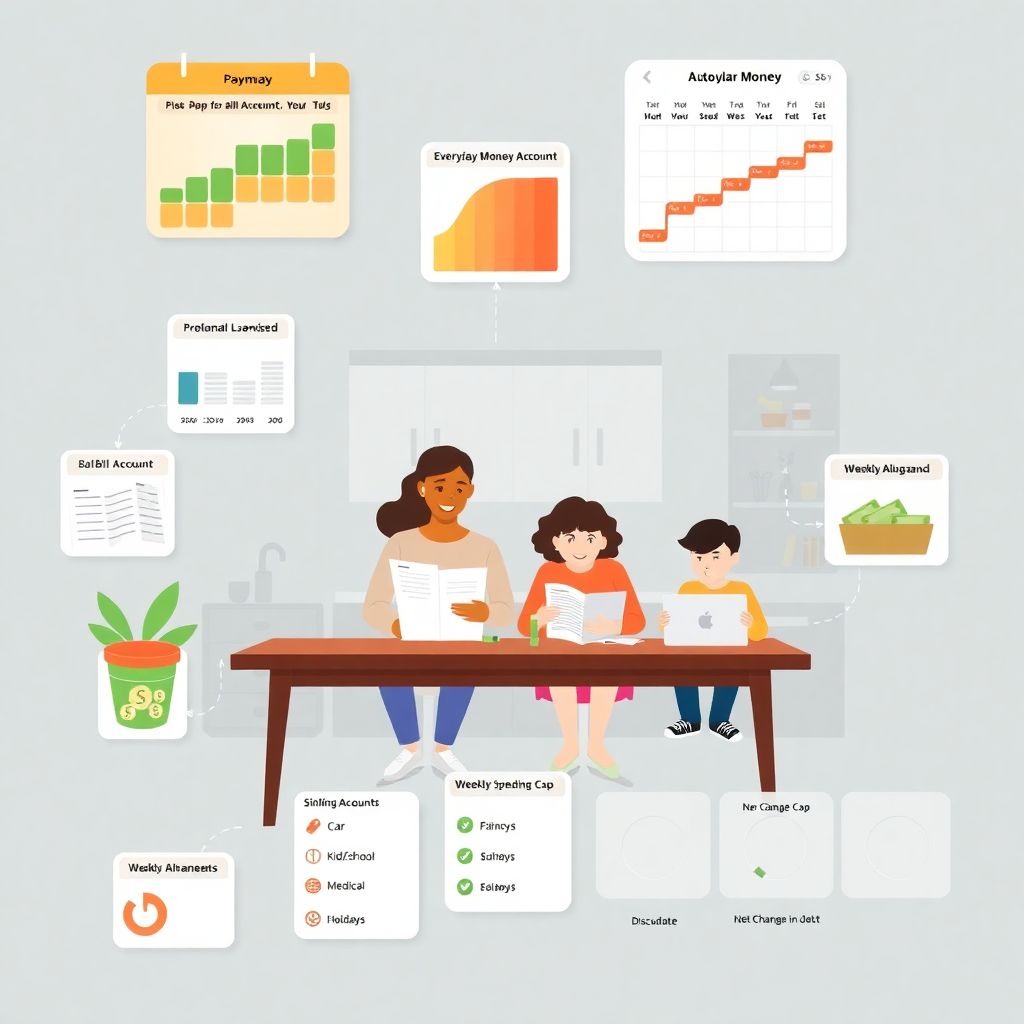
Why Cash Flow Matters More to Families Than “Being Good with Money”
Most parents don’t have a “spending problem”; they have a timing problem. Money comes in unevenly, bills hit all at once, and a couple of surprise expenses wipe out the month. That’s not about discipline, it’s about cash flow. When you start thinking like a small business and apply cash flow optimization strategies for parents, the stress level drops fast – even if your income doesn’t change at all.
Cash flow optimisation for families is simply answering three questions every month:
1) When does money actually arrive?
2) When does it actually leave?
3) How do we control the gaps between these two dates so we’re never in panic mode?
Let’s walk through how to do this in practice, step by step.
—
Step 1: Turn Your Bank Statements into a Cash Flow Map
Most people “kinda know” their numbers, but cash flow hates “кinda”. You need a clear, visual map of what’s happening. Take the last three full months of bank statements. Your goal is not to judge your spending yet, but to understand the rhythm of money in your household: when salaries arrive, when rent or mortgage goes out, what hits around the 10th, 15th, and 25th.
Print or export the transactions and mark: green for inflows (salary, benefits, side gigs), red for outflows (bills, food, subscriptions) and yellow for irregulars (repairs, gifts, one‑offs). This is the raw data you’ll use for personal financial planning for families that actually reflects reality, not wishful thinking.
Technical detail: Categorising inflows and outflows
To use family cash flow management services effectively or DIY it, you need consistent categories. At a minimum:
– Inflows: primary income, secondary income, benefits, refunds, tax credits.
– Fixed outflows: housing, utilities, insurance, debt payments, childcare.
– Variable essentials: groceries, transport, phone/internet, school‑related costs.
– Lifestyle: eating out, entertainment, shopping, hobbies, subscriptions.
– Future you: savings, investments, sinking funds (we’ll get to those).
Once you classify three months, you can see averages and spot weird spikes. Those spikes are often why the month “suddenly collapses” near the end.
—
Step 2: Build a Family Cash Flow Calendar, Not Just a Budget
A traditional budget says, “We spend $X on groceries per month.” Cash flow asks, “On which weeks do we actually spend it, and what else hits the account that week?” This calendar view is where families start to feel in control. On a blank calendar, add all your recurring inflows on the dates they arrive and all your fixed bills on the dates they’re charged, including subscriptions and automatic payments.
When you stand back, you will usually see “heavy weeks” where rent, loan payments and childcare all cluster together. This explains why you’re forced to use overdraft or credit cards even if the total monthly numbers look okay. You don’t have an income problem; you have a calendar problem that can often be fixed with a few phone calls.
Technical detail: Shifting due dates to smooth cash flow
In real practice, about 60–70% of fixed bills can be moved to different days of the month. Call your utility providers, credit card companies, and sometimes even your landlord or lender, and ask to change the billing date to align with payday. For example, if your main salary arrives on the 5th and 20th, aim to have housing and major debts hit just after those dates. Over two to three months, you can restructure due dates so each week has a predictable, manageable outflow, reducing “bill pile‑ups” that break your cash flow.
—
Step 3: Separate “Everyday Money” from “Bill Money”
One of the simplest and most effective cash flow optimization moves for families is opening a dedicated “bill account”. Your salary lands in Account A, and a calculated amount is transferred to Account B to cover all fixed monthly obligations. You don’t touch Account B except for bills. Whatever is left in Account A after that transfer is your “everyday money” for groceries, fuel and small daily expenses.
In practice, this instantly answers the question, “Can we afford this restaurant tonight?” If paying it means dipping into the bill account, the answer is no. If it fits inside the everyday account until the next payday, the choice is yours. You no longer have to keep all numbers in your head or mentally subtract upcoming bills from your current balance at the checkout line.
Technical detail: How to calculate the bill account transfer
Add up all fixed monthly expenses: rent/mortgage, utilities, insurance, minimum debt payments, childcare, subscriptions. Suppose it totals $2,400. If you’re paid twice a month, divide by two and add a 5–10% buffer:
– $2,400 ÷ 2 = $1,200
– 10% buffer = $120
– Transfer per paycheck = $1,320 into the bill account.
Automate this transfer on payday. Over 2–3 months, adjust the buffer as you spot forgotten bills. This transforms family cash flow management services from vague advice into a precise, automated system.
—
Step 4: Use “Sinking Funds” to Kill Surprise Expenses
Kids’ birthdays, back‑to‑school shopping, car repairs – these are not emergencies; they’re irregular but predictable expenses. Families often end up using credit cards for them because they don’t show up every month, so they’re ignored in planning. Sinking funds change that: you set aside small, regular amounts for known future costs.
Think in annual amounts. If you typically spend $900 a year on car maintenance, that’s $75 a month. If school expenses average $600 a year, that’s $50 a month. Create separate digital “buckets” (many banks now allow this) and transfer these amounts right after payday. When the expense arrives, the money is already waiting. The emotional difference is huge: instead of “Oh no, where do we get $300?”, you simply move it from the relevant fund.
Technical detail: Prioritising sinking funds
You don’t need 20 funds from day one. Start with 3–5 high‑impact areas: car, medical/self‑care, kids/school, gifts/holidays, and home maintenance. Assign each a target monthly amount. If your total target is $250 per month but you can only afford $150, scale them proportionally for now: car $60 instead of $100, kids $40 instead of $70, and so on. In cash flow terms, even partial funding is far better than pretending the expenses don’t exist. Over time, as debts shrink or income grows, you increase contributions.
—
Step 5: Turn Variable Spending into Weekly “Allowances”
Big families often leak money on small, frequent purchases: coffees, snacks, mini online orders. These aren’t evil, but they’re unpredictable. Instead of trying to monitor every line item, cap the total. Decide how much per week you can afford for “flexible spending”: groceries, fuel, small treats, minor kids’ needs. Then you track only this one number per week, not fifty categories.
Many couples set a shared weekly amount and individual no‑questions‑asked allowances. For example, $350 per week for shared spending and $40 per adult per week for personal use. This respects autonomy and cuts down arguments like “You bought another gadget” or “You ordered takeout again.” The rule is simple: if it fits the weekly cap, it’s fine. If not, it waits.
Technical detail: Choosing weekly vs monthly controls
Weekly caps work better than monthly for two reasons: behaviour and feedback speed. Behaviourally, humans handle four smaller limits better than one giant number. If you overspend this week, you feel it quickly and can tighten next week. From a cash flow perspective, weekly limits align with how often we shop for food and small items. If you’re paid bi‑weekly, sync your weeks to pay cycles and adjust: two “strong” weeks with more cash, two “lean” weeks where you consciously slow down but don’t panic.
—
Step 6: Use Tools, but Don’t Let Them Replace Thinking
family budgeting and cash flow software can be powerful if you treat it as a dashboard, not a babysitter. Apps like YNAB, Monarch, or even a well‑built spreadsheet help you see patterns, test “what if” scenarios, and track whether you’re actually following your cash flow plan. The key is to design the structure first on paper, then implement it in software, not the other way around.
Remember: most apps are built for generic personal finance, not specifically for parents juggling daycare, school fees, and uneven incomes. Adapt them ruthlessly to your reality. You may need custom categories for extracurriculars, shared custody arrangements, or seasonal work. The tech should reflect your life, not force you into categories that look neat but hide real‑world pressure points.
Technical detail: Minimal data to track consistently
For how to optimize household cash flow without drowning in data, track only these metrics each month:
1) Total fixed expenses vs total inflow (aim for ≤50–60% of after‑tax income).
2) Total variable essentials (groceries, transport) – watch for creep.
3) Amount moved to sinking funds and true savings.
4) Net change in debt balances.
If a tool doesn’t make these four numbers clearer, it’s noise. Good software should answer, at a glance: “If next month looks like this month, are we moving forward or backward?”
—
Real‑World Example: The “Always Behind” Family
A couple with two kids came in with what they called a “chronic chaos” situation. Combined net income: about $5,200 per month. No luxury spending, but they were constantly using overdraft and paying $120–$150 in bank fees and interest monthly. On paper, their rough budget said they needed around $4,800 to live. So where was the money going?
Once we did a three‑month cash flow map, the pattern jumped out: rent, car loan, childcare and two credit card minimums all hit within five days of payday. Groceries for the whole month were mostly bought in the first two weeks. By day 15, they were deep in overdraft, then played “catch up” when the second salary arrived. The core issue was timing, not only spending levels.
What changed in practice
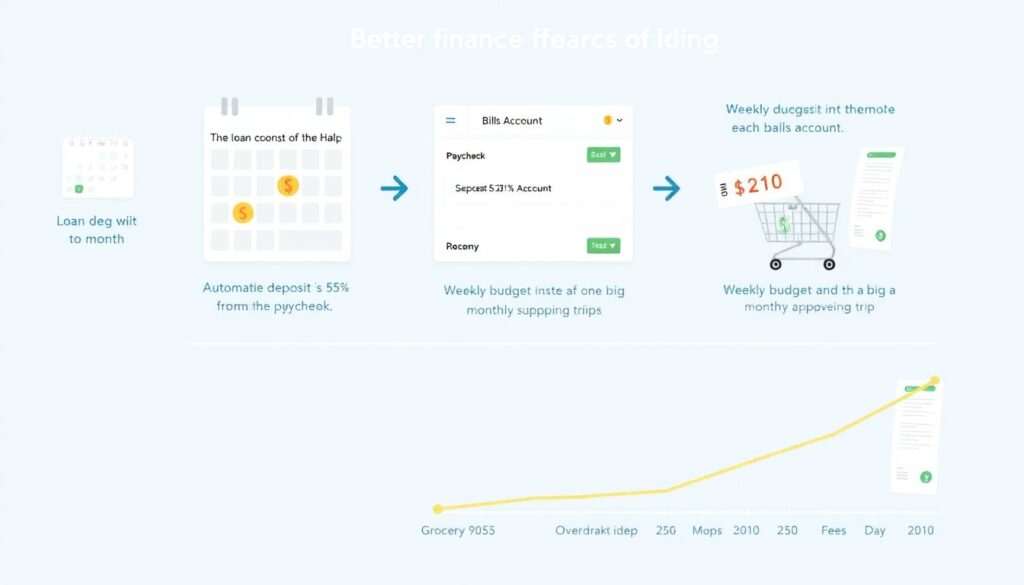
We did three things:
1) Moved two loan due dates to the second half of the month.
2) Opened a bill account and automated 55% of each paycheck there.
3) Switched groceries to a weekly cap of $210 instead of front‑loading shopping.
Within two months, overdraft usage dropped to almost zero, bank fees disappeared, and they freed up roughly $140 per month without cutting a single meaningful category. That $140 started feeding sinking funds: car, school, and small home repairs. After six months, they had a $1,000 buffer and reported something more important than the numbers: “We don’t fight about money every Sunday night anymore.”
—
Debt, Credit Cards and Family Cash Flow
Debt, especially credit cards, is usually a symptom of a broken cash flow system. If your current pattern forces you to use credit to survive certain weeks, any repayment plan that ignores timing will fail. You’ll pay extra one month, then need to swipe again the next month. The priority is to stabilise the monthly rhythm first – even if that slows down debt payoff for a few months.
Once inflow and outflow timing is under control, you can choose a focused strategy: avalanche (highest interest first) or snowball (smallest balance first). For many parents, the snowball works better psychologically. But from a pure numbers standpoint, shaving a 22% interest card has huge long‑term impact. Mix both: clear a small nuisance balance for motivation, then attack the highest rate.
Technical detail: Structuring payments around cash flow
Align extra debt payments to your “strongest” week – usually right after the biggest paycheck and essential bills are covered. For example, if you have $300 left after all necessities and sinking funds, commit a fixed $200 to debt and leave $100 as extra buffer. Automate the $200 so it doesn’t get absorbed by random spending. Re‑evaluate quarterly: as balances drop, redirect freed minimum payments to the next target, compounding your payoff speed without changing your lifestyle month to month.
—
Advanced Move: Treat One Partner’s Income as “Future Money”

If your household has two incomes and you’re not living on the edge, an advanced cash flow hack is to run the core household on one income and direct most of the second income to medium‑ and long‑term goals. This is high‑leverage personal financial planning for families who want to accelerate saving or reduce work‑related stress later.
In practice, you first stabilise everything using the steps above. Then you calculate: “What’s the minimum reliable income we can design the base lifestyle around?” Whatever is left from the second income becomes a powerful tool: building a six‑month emergency fund, speeding up mortgage payoff, funding kids’ education, or creating a “career flexibility fund” so one parent can change jobs or reduce hours without panic.
Technical detail: Guardrails for the “one‑income base”
Three rules keep this strategy safe:
1) The base income must cover all fixed costs plus modest variable essentials.
2) At least 10–15% of total household inflow still goes to savings/long‑term goals.
3) The second income is never fully pre‑committed; keep 20–30% of it as discretionary to avoid feeling overly restricted.
This approach turns cash flow into a strategic tool for life design, not only survival. You’re not just preventing crises; you’re buying future options.
—
Putting It All Together: A Simple Weekly Routine
Cash flow optimisation sounds complex on paper, but day‑to‑day it can be boiled down to a short weekly check‑in. Pick one fixed time, for example Sunday evening, and look at three things: current account balances, bills due in the next 7–10 days, and remaining weekly spending cap. If you’re partnered, this is a 15‑minute meeting, not a 2‑hour interrogation.
You’re not debating every transaction; you’re checking the system. If something went off – a bigger‑than‑usual grocery bill, a forgotten school payment – you adjust the coming week instead of panicking at the end of the month. Over time, these small, calm corrections compound. That’s what sustainable family cash flow management services should aim for: less drama, more predictable decisions, and the quiet confidence that money supports your family’s life instead of constantly disrupting it.