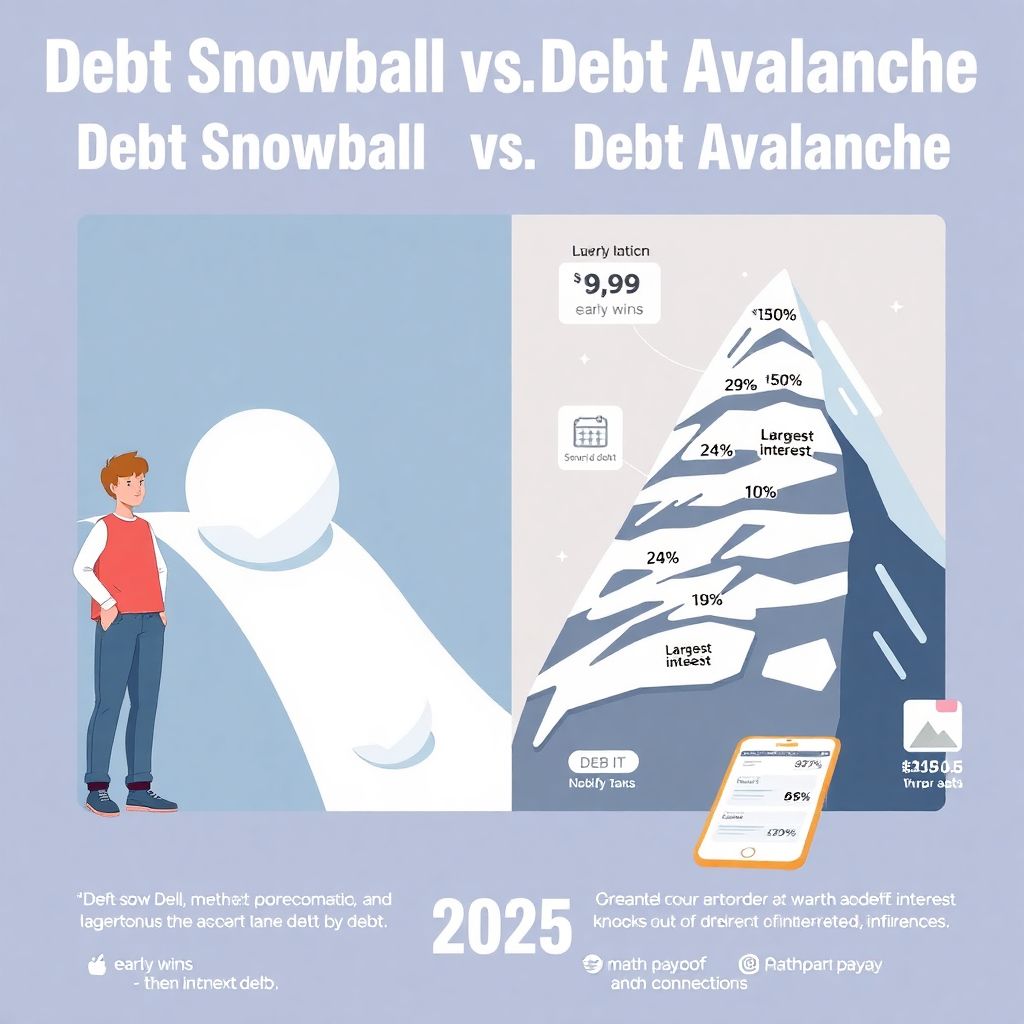
Why Debt Snowball vs. Debt Avalanche Still Matters in 2025
In 2025, personal finance looks very different from ten years ago. Interest rates jumped, then wobbled. Buy Now, Pay Later turned into “Oh no, pay everything.” Crypto fortunes came and went. Yet amidst all the hype, two boring, old-school systems are still the best-tested tools for getting out of debt: the debt snowball and the debt avalanche.
When people search for the best debt payoff method snowball vs avalanche, they usually want a clear winner. But the smarter question is: *Which method fits your behavior, your stress level, and your current life setup?* Because that, not math in a vacuum, is what usually decides whether you finish the plan or abandon it in month three.
—
Quick Refresher: What Are Snowball and Avalanche?
Debt Snowball: Momentum First, Math Second
The debt snowball method sorts your debts from smallest balance to largest balance, ignoring interest rates at first. You pay minimums on everything, then throw every extra dollar at the smallest debt until it’s gone. Then you roll that freed-up payment into the next smallest, and so on.
Short version:
– Focus: Smallest balance first
– Goal: Early wins and motivation
– Tradeoff: You may pay more interest over time
It’s the method that works well if you’re motivated by visible progress. In 2025, with constant distraction and “doomscrolling,” that psychological win can be a big deal.
Debt Avalanche: Math First, Momentum Later
The debt avalanche method sorts your debts from highest interest rate to lowest. You still pay minimums on everything, but all extra money attacks the highest-interest debt first.
So:
– Focus: Highest interest rate first
– Goal: Minimize total interest paid, finish faster on paper
– Tradeoff: Wins can feel slower, especially if your largest interest debt is also your largest balance
Think avalanche as the engineer’s choice: optimized for efficiency, but occasionally rough on motivation.
—
The 2025 Reality: Why This Choice Feels Different Now
A decade ago, this was mostly a theoretical debate on blogs. In 2025, the context is tougher:
– Many people carry multiple credit cards, BNPL plans, and personal loans.
– Variable rates mean you can’t always predict future interest costs.
– Financial stress is higher, and attention spans are shorter.
That’s exactly why a credit card debt repayment strategy comparison snowball avalanche isn’t just about math anymore. It’s about which strategy you can actually live with while working from home, juggling side gigs, or riding the gig-economy roller coaster.
—
Necessary Tools Before You Start
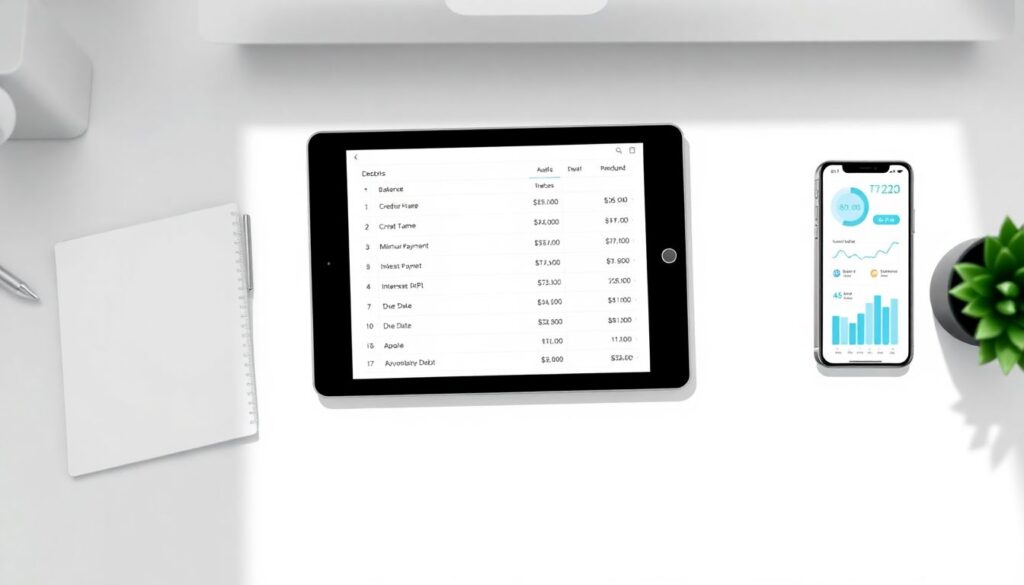
You don’t need a finance degree or fancy software, but a few tools make the process smoother and more “2025-proof.”
1. Accurate list of all debts
– Creditor name
– Balance
– Minimum payment
– Interest rate (APR)
– Due date
2. Digital tracking method (pick one and stick to it)
– Budgeting app or debt payoff app
– Simple spreadsheet
– Even a shared note on your phone
3. A debt snowball calculator online or an avalanche calculator
These tools show payoff timelines and interest saved. Use them to compare scenarios and to test your plan before committing.
4. Automation options
– Bank bill-pay
– Auto-pay from your checking account
– App-based reminders and notifications
5. Optional but powerful: external accountability
Some people decide to hire financial coach for debt snowball or avalanche plan to add structure and an outside perspective. In 2025, this often happens via Zoom, chat, or even asynchronous voice notes—very flexible, but still highly effective.
—
Step-by-Step: How to Build Your Debt Plan
1. Gather Everything in One Place
This is the least glamorous part and the one people put off. Log into every account: credit cards, personal loans, car loans, buy-now-pay-later, store cards, student loans. Write down the balances, rates, and minimums.
If you’re unsure of a rate, check statements or the “account details” section. Guessing here will wreck any careful comparison between strategies.
—
2. Decide How Much You Can Actually Throw at Debt
Before you pick snowball or avalanche, figure out your monthly debt budget beyond minimum payments.
– Track your spending for a month (use your banking app or a tracker).
– Cut the obvious stuff first: unused subscriptions, convenience food, impulse buys.
– Decide on a realistic extra payment amount. It should stretch you a bit but still be sustainable for at least six months.
In 2025, incomes can be volatile (freelance, gigs, commissions), so consider setting a base extra amount plus a rule like “50% of any freelancing or bonus money goes to debt.”
—
3. Run the Numbers: Snowball vs Avalanche
Now do a side-by-side comparison.
1. Open a debt snowball calculator online and enter all your debts.
2. Note:
– Estimated payoff date
– Total interest paid
3. Then run the same numbers using the avalanche order (highest APR first).
You’ve just done a personal credit card debt repayment strategy comparison snowball avalanche that’s specific to your real numbers, not some generic example.
Ask yourself:
– How much more interest does snowball cost compared to avalanche, in dollars?
– How much faster is avalanche, in months?
– Are those differences big enough to outweigh motivation and sanity?
—
4. Choose: Emotion-First or Math-First?
This is the pivotal decision.
Use this mental rule of thumb:
1. If your interest rate spread is small (for example, most debts between 16–22%), and the interest difference between methods is modest, snowball is usually fine and often better for motivation.
2. If you have one or two extremely high-interest debts (like a 29% store card or subprime card), and avalanche wipes out thousands in interest, avalanche starts looking very compelling.
3. If you know you tend to lose interest in long-term plans, snowball may keep you emotionally engaged.
Think behaviorally: what plan are you more likely to stick with in month 7 when life gets messy?
—
5. Lock In Your Payment Order
Once you’ve picked a method:
1. Sort debts:
– Snowball: smallest balance → largest
– Avalanche: highest APR → lowest
2. Label them on your spreadsheet or app: #1, #2, #3, etc.
3. Mark your target debt (the one you’re attacking right now).
This sounds trivial, but clarity is what allows you to act automatically, especially on busy or stressful days.
—
6. Automate the Boring Parts
Set up:
– Automatic minimum payments for every debt (so you never accidentally miss a payment).
– One extra manual or automated payment each month directed only at your current target debt.
Consider timing the extra payment for right after payday. Money you never see in your checking balance is money you’re less tempted to spend.
—
7. Review Monthly, Adjust Quarterly
In 2025, your situation can change fast: job shifts, side gigs, surprise rate changes. Once a month:
– Check balances and confirm payments posted correctly.
– Celebrate any debt you’ve completely eliminated.
– Decide if you can bump your extra payment even slightly.
Every three months, do a quick mini-audit: Is your method still working? Has your high-rate debt profile changed? If a card jacks up its APR, avalanche might suddenly make more sense—so stay flexible.
—
Where Does Debt Consolidation Fit In?
A lot of people now ask: debt consolidation vs snowball vs avalanche which is better?
Consolidation usually means combining several debts into one new loan or one balance-transfer card, ideally at a lower interest rate. That can:
– Simplify your life (one payment instead of seven)
– Potentially cut interest and speed payoff
But it doesn’t replace snowball or avalanche. It just changes the starting conditions:
– After consolidation, you may only have one or two debts, so the strategy choice is simpler.
– If some debts remain unconsolidated, you can snowball or avalanche those around the new consolidated loan.
Consolidation can be powerful in 2025, but only if you pair it with a clear payoff system and better spending habits. Otherwise, people end up with a new consolidation loan *plus* new card balances, which is the worst of both worlds.
—
Troubleshooting: When Your Plan Starts Falling Apart
Even the best plan hits real-life friction. Here’s how to debug common problems.
Problem 1: “I Keep Raiding My Extra Debt Money”
If your extra payment keeps getting swallowed by surprise expenses:
1. Prioritize a small starter emergency fund (even $500–$1,000) before going aggressive on debt.
2. Move your “debt extra” money to a separate checking account that auto-pays the target debt. Don’t let it sit in your main spending account.
3. Set up micro-automations: weekly $20 transfers add up and are less noticeable than big monthly chunks.
If this keeps happening, snowball might fit better than avalanche simply because early debt eliminations free up cash and reduce mental load faster.
—
Problem 2: “I Feel Like I’m Not Making Progress”
This is common with avalanche, especially if your highest-rate debt is large.
Try this:
– Track the *total* debt balance month over month. Even a $150 drop is real progress.
– Mark non-numeric milestones: “Paid off half of Card A,” “Interest charges dropped by $40/month.”
– If your motivation is tanking, consider temporarily switching from avalanche to a hybrid: clear one small-balance card for a psychological win, then go back to avalanche priorities.
Motivation is not fluff; it’s a performance factor. Losing it is often what kills long-term payoff plans.
—
Problem 3: “New Debt Keeps Appearing”
If you’re paying old debt while quietly adding new debt, you’re stuck in a treadmill.
1. Identify the trigger: Is it irregular income, medical costs, housing, or lifestyle?
2. Focus on the weakest link. For instance:
– If irregular income is the issue, build a bare-bones budget based on your lowest recent 3-month average income.
– If it’s lifestyle creep, apply a temporary rule like “no new subscriptions, no new financing offers until X debt is gone.”
3. Freeze or lock your cards in your banking app. Many card issuers now allow this with one tap.
This is exactly where some people choose to hire financial coach for debt snowball or avalanche plan—a coach can help analyze patterns, not just numbers, and help you design guardrails tailored to your habits.
—
Problem 4: “I’m Overwhelmed by So Many Accounts”
Too many lines of credit create decision fatigue.
To simplify:
– Align as many due dates as possible (many lenders will change them if you ask).
– Use one dashboard—an app or spreadsheet—to see everything at a glance.
– Consider a targeted consolidation move only for high-rate credit card clusters, if the math checks out and you trust yourself not to re-borrow.
Simplification alone can make either snowball or avalanche feel dramatically easier.
—
Modern Tweaks: Blending Strategies in 2025
You don’t have to be rigidly “team snowball” or “team avalanche.” In 2025, with customizable apps and flexible tools, hybrid strategies are normal.
Some useful blends:
– Snowball start, avalanche finish
Knock out 1–2 smallest balances quickly to free up mental space, then reorder the remaining debts by interest rate and go full avalanche.
– Avalanche core, snowball boosts
Mostly follow avalanche, but anytime you’re within a month or two of wiping out a small balance, prioritize it briefly for the psychological win.
– Income-based surges
During high-income months (bonuses, peak season, tax refund), slam extra at the highest-interest debt. During lower-income months, stick to minimums plus a small snowball boost for motivation.
The point: your strategy can evolve. Just be explicit when you change rules, so you don’t drift into random, reactive decisions.
—
Putting It All Together
Let’s wrap it into a simple decision path you can act on right now:
1. List every debt with balance, minimum payment, and APR.
2. Decide your monthly extra debt amount that’s realistic for the next six months.
3. Use a calculator to compare snowball vs avalanche (timeline and interest difference).
4. If the interest savings with avalanche are huge and you handle delayed gratification well, choose avalanche.
5. If you crave quick wins or the difference in interest is modest, choose snowball.
6. Set up automatic minimums plus one focused extra payment on your #1 target debt.
7. Review monthly, adjust every three months, and evolve your method if your life or interest rates change.
Both methods work. The “best” method isn’t the one with the prettiest spreadsheet; it’s the one you’ll still be following 12 months from now, regardless of market headlines, social media noise, or the latest financial trends.
If you treat your payoff method as a long-term system instead of a January resolution, snowball or avalanche can turn 2025 from “debt chaos” into the year your balance finally starts moving in the right direction—for good.